Showing posts with label smallholders. Show all posts

Saturday, June 8, 2013

5 Million Farmers Sue Monsanto for $7.7 Billion

Launching a lawsuit against the very company that is responsible for a farmer suicide every 30 minutes, 5 million farmers are now suing Monsanto for as much as 6.2 billion euros (around 7.7 billion US dollars).

The reason? As with many other cases, such as the ones that led certain farming regions to be known as the ‘suicide belt’, Monsanto has been reportedly taxing the farmers to financial shambles with ridiculous royalty charges.

The farmers state that Monsanto has been unfairly gathering exorbitant profits each year on a global scale from “renewal” seed harvests, which are crops planted using seed from the previous year’s harvest.

The practice of using renewal seeds dates back to ancient times, but Monsanto seeks to collect massive royalties and put an end to the practice. Why? Because Monsanto owns the very patent to the genetically modified seed, and is charging the farmers not only for the original crops, but the later harvests as well. Eventually, the royalties compound and many farmers begin to struggle with even keeping their farm afloat. It is for this reason that India slammed Monsanto with groundbreaking ‘biopiracy’ charges in an effort to stop Monsanto from ‘patenting life’.

Jane Berwanger, a lawyer for the farmers who went on record regarding the case, told the Associted Press:

“Monsanto gets paid when it sell the seeds. The law gives producers the right to multiply the seeds they buy and nowhere in the world is there a requirement to pay (again). Producers are in effect paying a private tax on production.”

The findings echo what thousands of farmers have experienced in particularly poor nations, where many of the farmers are unable to stand up to Monsanto. Back in 2008, the Daily Mail covered what is known as the ‘GM Genocide’, which is responsible for taking the lives of over 17,683 Indian farmers in 2009 alone. After finding that their harvests were failing and they started to enter economic turmoil, the farmers began ending their own lives — oftentimes drinking the very same insecticide that Monsanto provided them with.

As the information continues to surface on Monsanto’s crimes, further lawsuits will begin to take effect. After it was ousted in January that Monsanto was running illegal ‘slave-like’ working rings, more individuals became aware of just how seriously Monsanto seems to disregard their workers — so why would they care for the health of their consumers? In April 2012, another group of farmers sued Monsanto for ‘knowingly poisoning’ workers and causing ‘devastating birth defects’. More


Tuesday, March 19, 2013

Undercover sting exposes Malaysia land-grab

Allegations of corruption get louder following secret tapes showing plunder of resource-rich Sarawak province.

Mountains of Borneo Island

Long Napir, Malaysia - Plantations and logging are ravaging Malaysia's majestic Borneo region and indigenous people who have lived for centuries here say they are increasingly being uprooted from their once-pristine lands.

But as the timber and palm oil companies swarm over the rugged landscape of resplendent rivers and ancient rainforests, villagers in Long Napir in the country's biggest state Sarawak have vowed to thwart any further land-grabs.

The village is a settlement of longhouses, the traditional communal housing favoured by indigenous people in eastern Malaysia's Borneo island.

Under the Sarawak Land Law, indigenous people have rights over areas as long as they can prove they have lived in or used the lands prior to January 1, 1958.

"We have no land to farm, our rivers have become muddy, there's hardly any fish left anymore."

- Tamin Sepuluh Ribu, villager

But the surrounding ancient rainforests that are so essential to their traditional way of life is under threat because of logging and plantation companies. Over the past 30 years, Sarawak - one of the richest Malaysian states - has become one of the largest exporters of tropical timber.

Despite its wealth, profits have failed to trickle down, and the people here are some of the poorest in the country.

Long Napir villagers lay the blame for their plight squarely on one man: the state's powerful chief minister, Abdul Mahmud Taib, who is in charge of all land classification and the allocation of lucrative forestry and plantation licenses.

"He lives, the rest of us suffer," Tamin Sepuluh Ribu, a former village headman, told Al Jazeera. "We have no land to farm, our rivers have become muddy, there's hardly any fish left anymore."

'Coterie of cronies'

Global Witness, a non-governmental organisation working against environmental exploitation, has investigated and exposed the situation in remote eastern Malaysia.

An undercover Global Witness investigator posing as an investor was offered several opportunities to purchase land in Sarawak by company officials linked to Chief Minister Taib. In each instance, the land in question was occupied by indigenous communities, who have valid claims to ownership rights under Malaysian law.

Global Witness said the indigenous areas were being sold by companies with close personal or political ties to the chief minister.

Taib has held the post since 1981, and has been repeatedly accused of corruption during his nearly 32-year rule.

The US Embassy in Kuala Lumpur noted in one cable released by WikiLeaks: "Chief Minister Taib Mahmud … doles out timber-cutting permits while patrolling the underdeveloped state using 14 helicopters, and his family's companies control much of the economy."

The American cable added that, "All major contracts and a significant portion of land to be converted to palm oil plantations [including on indigenous 'customary land rights' that the state government has refused to recognize] are given to these three companies."

People in Sarawak are "fed up" with Taib's administration, "seen as only enriching his family and a small coterie of cronies", it said.
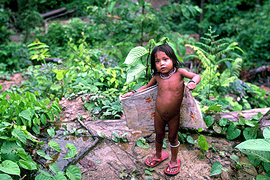
A Penan girl deep in the Borneo rainforests [EPA]

Under investigation

Global Witness released a November 2012 report titled, "In the future, there will be no forests."

"Taib's powerful executive position and personal responsibility for the issuance of lucrative logging and plantation licences has enabled him to systematically extract 'unofficial payments' from the state's timber tycoons for the enrichment of himself and his family," the report said.

Taib, meanwhile, denied the corruption allegations as "wholly untrue and malicious", said the report.

In 2011, the Malaysian Anti-Corruption Commission launched an official investigation into Taib, which continues at present.

In secretly taped negotiations provided to Al Jazeera, the Global Witness investigator discussed buying land with company shareholders Fatimah Abdul Rahman and Norlia Abdul Rahman - Taib's first cousins. Fatimah admitted the parcel of land under discussion had been transferred to them by Chief Minister Taib.

"Yeah, he's the one who gave us the land. He's my cousin," Fatimah said, laughing.

In 2011, Taib gave his cousins 5,000 hectares of land for about $300,000 dollars, according to leaked land registry documents. Having secured agriculture and timber licences, they were trying to sell it a year later for more than $16mn.

Later, discussing the ease of receiving a forestry license, Fatimah told the Global Witness investigator: "The Land and Survey Department, they are the ones that issue this licence. Of course, this is from the CM's [Chief Minister's] directive, but I can speak to the CM very easily." More


Friday, March 15, 2013

How agroforestry schemes can improve food security in developing countries

Agroforestry has multiple benefits, it's important that they are raised in food security debates so that they can reach their potential.

Agroforestry – the integration of trees and shrubs with crops and livestock systems – has strong potential in addressing problems of food insecurity in developing countries. Done well, it allows producers to make the best use of their land, can boost field crop yields, diversify income, and increase resilience to climate change.

To date, the uptake of agroforestry has been constrained partly because it has lacked a natural 'home' in policy space, but that may be changing thanks to a growing body of evidence of what it can achieve, and how to make it work. The FAO last month published a guide to advancing agroforestry on the policy agenda with case studies of best practice, and is due to hold a conference on forests and food security and nutrition in May.

"In recent years we've seen increasing interest in agroforestry as an important component of sustainable land use and development," says Douglas McGuire, team leader on the FAO's Forest Resources Management team. "The many advantages it offers are being better understood."

Much of that new understanding has come from the FAO itself and from the World Agroforestry Centre (ICRAF), which has built up a body of research on issues such as the use of particular tree varieties and how they can improve soil quality, complement specific field crops, and generate new income streams for smallholders.

For example, one of the major potential benefits of on-farm trees is their ability to replenish nutrient-depleted soil, and the results of a 12-year study by ICRAF published in September 2012 showed how the planting of a particular tree variety – Gliricidia – as a fertiliser tree alongside maize improved the stability of harvests of this staple food crop in sub-Saharan Africa.

The study, based on farming systems in Malawi and Zambia, foundGliricidia to be particularly effective at drawing nitrogen from the air and fixing it in the soil, reducing the need for large doses of manufactured nitrogen fertilisers. The leaves shed by the trees also replenish the soil, increasing its structural stability and capacity to store water.

Another fertiliser tree – Faidherbia, an indigenous African acacia – has also been found to be useful in agroforestry systems thanks partly to its unusual phenology. Faidherbia goes dormant and sheds its nitrogen-rich leaves during the early rainy season, when crops are being planted, and resumes leaf growth in the dry season. That means it fertilises crops at a useful time, but doesn't compete with them for light, nutrients or water.Several studies have found Faidherbia-maize inter-cropping to increase maize yields, by as much as 400% in one area of Malawi.

This doesn't mean that particular tree varieties should necessarily be pushed as "good" for all farming systems; rather, it's important to use the right trees in the right place. "There are often trade-offs involved, and these need to be carefully assessed and balanced, according to the objectives one is trying to achieve," says McGuire. "Soil fertility enhancement, erosion control, food production, wood production, and shading are all factors. Systems where wood production may be a main objective might not be the most favourable to enhancing soil fertility, but that may be an acceptable trade-off under the given circumstances."

Even where certain trees can bring clear benefits, they are often a long-term investment. Resource-poor smallholders can be reluctant to allocate land to trees when it might take years to reap the rewards. But depending on the objectives, certain varieties or planting techniques can speed things up.

"Calliandra and leucaena are two leguminous trees which are known to deliver relatively quick pay offs for use as fodder for livestock," says Frank Place, impact assessment adviser at ICRAF and co-editor of the FAO guide. More


Tuesday, March 12, 2013

Land Grabs Spread Throughout Developing World

Food Justice advocates have always argued that trade agreements need to respect and promote human rights, not drive a process of globalization that privileges commercial interests and tramples on public interests. In my new paper on land grabs from the Institute for Agriculture and Trade Policy, that position is affirmed.

“Land grabs” are large-scale purchases or leases of agricultural or forested land on terms that violate the rights of the people who live on or near that land. The problem has commanded enormous public policy and media attention for the last few years. In our paper, IATP sets some context for the land grabs phenomenon. We focus on two forces that have contributed significantly to the problem:

Globalization, or the deregulation of trade and foreign investment laws, which has greatly eased cross-border capital flows; relaxed the limits on foreign land ownership; and, opened markets to agricultural imports.

The food price crisis of 2007-08, which highlighted how fragile food systems in many parts of the world have become, and which shattered the confidence of net-food importing countries in international markets as a source of food security.

The situation is compounded by climate change and the resulting destabilization of weather patterns, which in turn has made agricultural production less predictable. Climate change has made domestic food supplies less certain and exports, too. In 2012, The United States, still a huge source of grains for international markets, lost 40 percent of a record large number of acres planted with corn to drought.

The sense of food insecurity has driven some of the richer net-food importers—countries such as Saudi Arabia and Kuwait—to invest in growing food abroad for import to their domestic markets. That is one driver of land grabs.

The sense that our food systems are fragile and that supplies are scarce, where for decades they have been abundant, is another driver—companies such as South Korea’s Daewoo are looking to source raw materials directly, rather than buying them on the market.

It’s not that investment in agriculture is a bad thing. Indeed, it’s sorely needed. But unless we have the conversation about what kind of investment, in what kind of agriculture, and in whose interests, then the investment does more harm than good.

Land grabs, as the label implies, have been overwhelmingly negative. They are associated with weak institutional capacity (and sometimes corruption) in the recipient country governments, as well as authoritarian governments in the investors’ home countries, making it hard to bring pressure there for better practices. The communities whose land is leased or bought are not adequately protected.

IATP proposes four linked policy shifts to create a more stable and transparent international food system:

1) Reformed trade rules that ensure export restrictions in times of crisis are subject to transparency and predictability requirements and that allow all countries policy space for food security policies;

2) Publicly-managed grain reserves to dampen the effects of supply shocks;

3) Readily accessible funding for the poorest food importers, which would be triggered automatically when prices increase sharply in international markets; and

4) The development of strong national and international laws to govern investment in land, respecting the principles and guidelines set out in the Voluntary Guidelines on Land Tenure. Tanzania’s recently announced limits on how much land foreign and domestic investors can lease is a hopeful example of a national government taking the initiative to get serious about regulation. More


Saturday, February 23, 2013

Monsanto Conquest Attempt Meets Aztec Resistance

Monsanto has a map for conquering the world and Mexico is in the center of it.

For nearly two decades the transnational corporation that manufactures the pesticides used across the planet has been trying to take over the global seed market with genetically modified (GM) seed. If successful, most of the food we grow and eat would have to be purchased annually as seed from Monsanto. The mutant plants would grow up addicted to Monsanto herbicides. Local varieties would disappear, and in their place standardized, genetically modified food–doused with chemicals–would fill supermarket shelves and corner stores.

More than sixty thousand farmers and supporters from workers’ and environmental organizations marched through Mexico City on Jan. 31 to avoid this fate. It was one of the largest mobilizations to date to reject the Monsanto game plan, and it’s no coincidence that it took place in the heart of the Aztec Empire.

Olegario Carrillo, president of Mexican small farm organization UNORCA, addressed the crowd in the central plaza, “During the last 30 years, successive governments have tried to wipe us out. They’ve promoted measures to take away our lands, our water, our seeds, plant and animal varieties, traditional knowledge, markets. But we refuse to disappear.”

“For peasant farmers, GMOs represent looting and control,” he stated.

With tens of thousands of people shouting “No genetically modified corn in Mexico!” and “Monsanto get out!”, the march showed the muscle of an unusual grassroots movement to protect small farmers and consumers. It also revealed the remarkable success of decades of public education and organizing on an issue that Monsanto and other major biotech firms hoped would slide under the radar of the people most affected by it.

Monsanto–along with Pioneer, Dow and other chemical/biotech firms– has been pushing hard to take over production of the world’s third major staple crop: corn. Small farmers in the U.S. have long experienced the pressure exerted to move them out of the way. Monsanto predicts that its corn seed will be planted on 96 million acres in the United States this year. But the key to its plans to conquer the market lies south of the border.

The powerful corporation, the largest seed seller in the world, desperately wants permission for unrestricted planting of its GM corn in Mexico. If GM corn is planted in Mexico, it will accelerate the transfer of acreage and water rights from small farmers to corporate GM corn cultivation, thus transferring control of the national food supply as well. Widespread open planting of GM corn will lead to contamination of native varieties. This is a scientific fact. Mexico has already detected many native cornfields contaminated by GM corn during the period when open planting was prohibited—a strong indication of the impossibility of controlling open pollination between native and GM varieties.

This has huge implications. Mexico is the center of origin of corn, and the home of hundreds of varieties developed by indigenous communities over centuries. To lose in situ preservation of these varieties is to lose a wealth of agro-diversity that has major importance for sustainable food production, and to eventually become dependent on Monsanto and other large corporations to feed ourselves.

The Mexican government first legalized GM plantings through what has come to be known as the 2005 “Monsanto Law”, which the farmers are demanding be revoked. It then began issuing permits, first for experimental plantings. Having passed that phase, Monsanto has now requested permits to begin all-out commercial production. It has filed to sow some 700,000 hectares of genetically modified corn in the state of Sinaloa alone. More


Sunday, September 23, 2012

Climate-Smart Smallholders

KIGALI – Until the world’s small farmers adopt a series of necessary changes, climate talks such as the United Nations Rio+20 Summit, which will take place in Rio de Janeiro this June, will never translate into action.

The emergence of a global green economy requires governments, other policymakers, and businesses from developed and emerging economies to recognize the inextricable linkages between climate change, the environment, and food security. This means bringing the world’s smallholder agriculture into the discussion.

Every day, smallholder farmers in developing countries confront the consequences of climate change. They are often the very first to fall prey to fickle global markets or extreme weather events.

Yet smallholders cannot be ignored when it comes to climate-change solutions: the world’s half-billion small farms account for 60% of global agriculture production and provide up to 80% of the food supply in developing countries. Together, they manage vast areas of our planet, including 80% of the farmland in sub-Saharan Africa and Asia.

Can we really count on these farmers, many of them desperately poor, to take a leading role in addressing the twin challenges of food security and environmental sustainability? Can they produce more food while protecting the natural environment?

We believe the answer to both questions is a resounding yes. Real-world experience shows that they can. But success is possible only if they can adopt environmentally sustainable techniques that preserve and enhance soil and groundwater.

Examples of how this can be done include terracing to prevent soil loss and degradation through erosion and flooding; radically reducing tillage; rotating crops and applying natural fertilizers – manure, compost, or mulch – to improve soil structure and fertility; and integrating trees with crops and livestock in agro-forestry systems. More