Showing posts with label aquifer. Show all posts

Thursday, November 23, 2017

Why These 8 States Could Soon Form the 'Great American Desert'


One of the world's largest underground bodies of fresh water—the Ogallala aquifer—is quickly shrinking, threatening the livelihoods of farmers in eight U.S. states.

Farmers in Colorado, Kansas, Nebraska, New Mexico, Texas, Oklahoma, Wyoming and South Dakota are overexploiting the aquifer beneath an American breadbasket, threatening an estimated $35 billion in annual crops. Agricultural wells are pulling out water faster than rainfall can recharge it—federal data shows the aquifer shrank twice as fast in the past six years as compared to the previous 60.

"Now I never know, from one minute to the next, when I turn on a faucet or hydrant, whether there will be water or not. The aquifer is being depleted," Lois Scott, 75, who lives west of Cope, Colorado, told the Denver Post.

In some parts of eastern Colorado the depth at which groundwater can be tapped has dropped by as much 100 feet, according to U.S. Geological Survey data. The USGS has released data on the Ogallala aquifer since 1988. In Colorado alone, farmers pumped water out of 4,000 wells, sucking out as much as 500 gallons per minute to irrigate roughly 580,000 acres. Since 1950 the amount of water used to irrigate farm fields across the eight states equals roughly 70 percent of Lake Erie.

Even if farmers drastically reduce pumping, the aquifer wouldn't refill for centuries, according to the latest research. But the eight states that sit on the Ogallala have no agreement among themselves to try to save the aquifer.

"This will truly become the Great American Desert," Scott said.

The fallout from the aquifer is visible above ground as well. Streams are drying up at a rate of six miles per year.

"We have almost completely changed the species of fish that can survive in those streams, compared with what was there historically. This is really a catastrophic change," Keith Gido, one of the authors of a report on the aquifer, told the Denver Post.


(https://www.ecowatch.com/ogallala-aquifer-depletion-2511600266.html?xrs=RebelMouse_fb&ts=1511357525

Wednesday, February 12, 2014

U.S.-India: Dealing With Monsoon Failure by Lester R. Brown

Earth Policy Book Byte Release - February 12, 2014

The following is an excerpt from Lester Brown’s new autobiography, Breaking New Ground: A Personal History. The first in his family to graduate from elementary school, he reveals what inspired him—and millions of those who have read his books—to become environmentally active. For more, check out Chapter 1, now up on our website, and browse through photo albums and hear from Lester Brown himself in select videos.

The scene plays out in India in 1965.

At a reception, I met the head of Indian operations for Esso (now ExxonMobil). When I asked him how business was, he said it was great. In particular, diesel sales to fuel irrigation pumps were nearly double the previous year’s level. Why? Because farmers were pumping continuously to try to save their crops.

Soon after, I met an embassy staff person, an avid duck hunter. He usually took off a few weeks in the fall to go hunting on a lake up north. This year he had canceled his vacation because the lake was dry.

An agronomist who worked with the U.S. Agency for International Development (USAID) traveled extensively in rural India and often stopped his car in the countryside to take soil samples. But he complained to me that he could no longer get good core samples: the soil was so dry it crumbled and fell out of his auger as he withdrew it.

This was something that I had never seen in my years of farming. I became convinced that India faced a huge crop shortfall.

It was the fall of 1965 and I had come to India because the USAID mission in New Delhi had asked the U.S. Department of Agriculture (USDA) for someone to help them with an agricultural analysis.

What caught my attention in New Delhi right away was the condition of that year’s grain crop. The Indian government officially estimated grain demand for 1965 would be 95 million tons. I soon began to wonder whether a harvest anywhere near this amount would materialize. I found reports of drought in virtually every corner of the country. The drought appeared to be almost everywhere.

Since the United States was the dominant world grain supplier—the only country that could even think about filling a deficit of this scale—this warranted an urgent cable to alert my boss, the U.S. Secretary of Agriculture Orville Freeman. If a potential deficit of this magnitude was a real prospect, he needed the information as soon as possible.

However, if I were going to sound such an alarm, I needed to estimate the size of the deficit, despite having only fragmentary data. If my estimate of the deficit was too high, the United States would over mobilize and waste resources. But if my estimate was too low, that could lead to famine. I worked to strike the right tone in the cable to Freeman.

Off to Rome

The cable actually went to Washington on Wednesday, November 10. On Friday of the following week, I received a cable from Secretary Freeman. It was short and cryptic: “Please meet me in Rome tomorrow morning.” He would be in Rome attending the biennial conference of agricultural ministers organized by the U.N. Food and Agriculture Organization.

At that point, I asked to meet with India’s minister of food and agriculture, C. Subramaniam, to share my assessment with him. I urged him not to play it down when he got to Rome—unless he was convinced that it was off base. Otherwise, the U.S. government would not mobilize its grain aid quickly enough and the needed shipments might not arrive in time.

When I met Secretary Freeman on Saturday morning, he said he had shared my cable with President Lyndon Johnson (LBJ). My analysis played to one of LBJ’s deepest concerns: that India was neglecting its agriculture as it concentrated on industrialization. Its government simply seemed to assume that the United States would fill any grain deficits that India might face.

Creating dependency

If India continued on this path, it would become dangerously dependent on the United States in the event of any crop shortfalls. That was all the more problematic as this was a time when scores of other countries also depended on U.S. grain.

President Johnson and his team knew that if the recent agricultural trends in India continued, eventually India’s grain needs would exceed the United States’ capacity to meet them. When an Indian official was asked by a reporter about the adequacy of the country’s grain stocks, he responded, “Our reserves are in the grain elevators in Kansas.”

It was this casual thinking about food security in India, then a country with a population more than double that of the United States and growing by 10 million per year that alarmed the U.S. president. It led to what came to be known as the “short-tether policy” on U.S. food aid.

Constructive conditionality

LBJ had asked Secretary Freeman to get a commitment from the Indians to develop their agriculture—and fast. Any continuing food aid from the United States would be contingent on this.

India was facing a potentially massive famine. I wanted to make sure that both governments understood the gravity and urgency of the situation. Rarely have two governments been in a situation where the stakes, measured in human lives, were so high.

Freeman, Subramaniam and I met on Monday morning to discuss the situation. They asked me to draft an agreement between the two countries based on our discussion. At the end of the day, I had a draft. The agreement was short, three pages double-spaced.

I knew what India had to do. The government’s food price policy, which catered to the urban population by imposing ceiling prices on wheat and rice, had to be replaced. What was needed was a floor price guarantee for the farmers growing these grains. Fertilizer supplies had to increase rapidly. This meant shifting fertilizer production from the public sector to the private sector.

There were high-yielding dwarf varieties of wheat. Initially developed in Mexico by Norman Borlaug and his colleagues with support of the Rockefeller Foundation, they had been tested in India and performed very well. India needed to accelerate the dissemination of these high-yielding wheats.

Creating linkages across borders

Once we had negotiated the agreement that contained these essential points, Freeman cabled a draft to LBJ for approval. The president approved it immediately and Secretary Freeman signed the agreement. In essence, he committed the United States to providing massive food assistance—as long as India adopted the reforms.

The Indian government’s original five-year agricultural plan was a much longer, detailed bureaucratic document. My new draft was only a few pages on the key initiatives needed. Its strength was that it linked the movement of wheat from the United States to the implementation of a new food production strategy in India. The monsoon failure and the massive looming grain deficit had changed everything.

Inside the Indian government, Agriculture Minister Subramaniam took all the necessary steps. In effect, he said: Our agriculture is in trouble. We could be facing a huge grain deficit, a potentially massive loss of life. We have to reform our agriculture. Here is what we need to do.

You reform, we deliver

One thing the Indians did not anticipate was the extent to which the Johnson Administration was going to use food aid to force the Indian government to follow through on every measure in the agreement. If the Indian government did not accomplish certain measures, the ships would stop leaving U.S. ports.

It took the Indians a while to realize that LBJ was dead serious about the reforms. Several times in the months ahead, the ships stopped sailing because India had not fulfilled its part in implementing the bilateral agreement. They would move again only when India had met its commitments.

The greatest challenge was actually importing the 10 million tons of grain in a single year when India previously had never imported anywhere near this amount before.

To assess whether—and how—this massive amount could be moved in time, Secretary Freeman called on logistics specialists in the USDA, men who had served in the Army Quartermaster Corps in World War II. During the war, they had become masters of moving equipment and arms from point A to point B. Their ingenuity was boundless.

Yankee ingenuity to help India

What they did to greatly increase India’s port capacity was to lease one of the largest supertankers afloat at the time, the Manhattan. They then anchored the massive ship in the Bay of Bengal and used it as a port.

On one side, ships from the United States arrived with grain that was pumped on board and then unloaded on the other side into small, flat-bottomed, local boats called dhows, which were about 30 feet long.

Thousands of dhows were used to move the grain up the Ganges River and its tributaries to reach the parts of the country where the drought was most severe and the risk of starvation the greatest. It was remarkably successful.

The result

Final data on the 1965 Indian harvest showed it coming in at 77 million tons of grain—18 million tons below the Indian government’s original estimated consumption. In the effort to stave off famine, the United States that year shipped a fifth of its wheat harvest to India.

At that time, it was the largest movement of food ever between two countries. Some 600 ships, nearly two a day, left U.S. ports laden with wheat for India. Measured by the number of ships used in a single logistical operation, it ranks high on the all-time list. This record flow of food from the United States to India avoided what could have been one of history’s most devastating famines.

With the new agricultural development strategy, India doubled its wheat harvest in seven years, a record for growth in production of a food staple in a major country. No country, not even the United States, had ever managed such rapid growth.

For the United States, this was one of our finest moments. And not just because millions of lives were saved, but because our government had seen a rare opportunity to restructure India’s agriculture by dramatically boosting land productivity. More

Could a similar scene play out again on the sub-continent due to a spike in oil prices or changes in monsoon? Editor

# # #

This essay is an adapted excerpt from Breaking New Ground: A Personal History, by Lester R. Brown, New York, W.W. Norton, 2013, and originally appeared in The Globalist on February 6, 2014. Photo albums, videos, and additional resources are available for free download at www.earth-policy.org/books/bng.

Feel free to pass this information along to friends, family members, and colleagues!

Media Contact: Reah Janise Kauffman (202) 496-9290 ext. 12 | rjk@earthpolicy.org

Research Contact: Janet Larsen (202) 496-9290 ext. 14 | jlarsen@earthpolicy.org


Tuesday, June 4, 2013

As Sea Waters Rise, Costal Communities in Pakistan Suffer

As global warming causes ocean water to creep farther up the Indus Delta, communities in Pakistan's coastal areas are suffering. A recent report from the World Wildlife Fund Pakistan highlights these challenges.

One farmer told WWF Pakistan he had to start fishing:

“Over the last few years, I sowed seeds in over 200 acres. But now my hands are empty. Only 15 acres is still fertile while the rest has become plagued by the problem of water-logging and salinity.”

Dawn.com reports over half of the population's livelihoods are threaten by climate change:

The majority of the people in Pakistan (between 60 to 70 per cent) depend on the eco-system to survive. A shepherd in Balochistan, a farmer in Punjab or a fisherman from Sindh — all rely directly on the environment for their livelihood. Unfortunately, the livelihood of these people is at risk due to climate change. More

Report from WWF Pakistan


Saturday, April 20, 2013

Sir John Beddington warns of major global crisis by 2030

One of Britain's leading scientists is warning that the growth of the world's population will reach crisis point by the year 2030.

John Beddington, the UK government's chief scientific adviser, says food and water supplies will come under severe pressure as the Earth's population swells to 8.5 billion people.


He says the answer is in embracing new agricultural technology.


Harry Smith reports.


Friday, March 15, 2013

How agroforestry schemes can improve food security in developing countries

Agroforestry has multiple benefits, it's important that they are raised in food security debates so that they can reach their potential.

Agroforestry – the integration of trees and shrubs with crops and livestock systems – has strong potential in addressing problems of food insecurity in developing countries. Done well, it allows producers to make the best use of their land, can boost field crop yields, diversify income, and increase resilience to climate change.

To date, the uptake of agroforestry has been constrained partly because it has lacked a natural 'home' in policy space, but that may be changing thanks to a growing body of evidence of what it can achieve, and how to make it work. The FAO last month published a guide to advancing agroforestry on the policy agenda with case studies of best practice, and is due to hold a conference on forests and food security and nutrition in May.

"In recent years we've seen increasing interest in agroforestry as an important component of sustainable land use and development," says Douglas McGuire, team leader on the FAO's Forest Resources Management team. "The many advantages it offers are being better understood."

Much of that new understanding has come from the FAO itself and from the World Agroforestry Centre (ICRAF), which has built up a body of research on issues such as the use of particular tree varieties and how they can improve soil quality, complement specific field crops, and generate new income streams for smallholders.

For example, one of the major potential benefits of on-farm trees is their ability to replenish nutrient-depleted soil, and the results of a 12-year study by ICRAF published in September 2012 showed how the planting of a particular tree variety – Gliricidia – as a fertiliser tree alongside maize improved the stability of harvests of this staple food crop in sub-Saharan Africa.

The study, based on farming systems in Malawi and Zambia, foundGliricidia to be particularly effective at drawing nitrogen from the air and fixing it in the soil, reducing the need for large doses of manufactured nitrogen fertilisers. The leaves shed by the trees also replenish the soil, increasing its structural stability and capacity to store water.

Another fertiliser tree – Faidherbia, an indigenous African acacia – has also been found to be useful in agroforestry systems thanks partly to its unusual phenology. Faidherbia goes dormant and sheds its nitrogen-rich leaves during the early rainy season, when crops are being planted, and resumes leaf growth in the dry season. That means it fertilises crops at a useful time, but doesn't compete with them for light, nutrients or water.Several studies have found Faidherbia-maize inter-cropping to increase maize yields, by as much as 400% in one area of Malawi.

This doesn't mean that particular tree varieties should necessarily be pushed as "good" for all farming systems; rather, it's important to use the right trees in the right place. "There are often trade-offs involved, and these need to be carefully assessed and balanced, according to the objectives one is trying to achieve," says McGuire. "Soil fertility enhancement, erosion control, food production, wood production, and shading are all factors. Systems where wood production may be a main objective might not be the most favourable to enhancing soil fertility, but that may be an acceptable trade-off under the given circumstances."

Even where certain trees can bring clear benefits, they are often a long-term investment. Resource-poor smallholders can be reluctant to allocate land to trees when it might take years to reap the rewards. But depending on the objectives, certain varieties or planting techniques can speed things up.

"Calliandra and leucaena are two leguminous trees which are known to deliver relatively quick pay offs for use as fodder for livestock," says Frank Place, impact assessment adviser at ICRAF and co-editor of the FAO guide. More


Tuesday, March 12, 2013

Freshwater Stores Shrink in Tigris-Euphrates Basin

Scientists using the twin gravity-measuring satellites of the Gravity Recovery and Climate Experiment (GRACE) have found that a large portion of the Middle East lost freshwater reserves rapidly during the past decade. The research team observed the Tigris and Euphrates river basins—including parts of Turkey, Syria, Iraq, and Iran—and found that 117 million acre feet (144 cubic kilometers) of fresh water was lost from 2003 to 2009. That amount is roughly equivalent to the volume of the Dead Sea. About 60 percent of the loss was attributed to the pumping of groundwater from underground reservoirs.

The two natural-color images above were acquired by the Landsat 5 satellite and show the shrinking of the Qadisiyah Reservoir in Iraq between September 7, 2006 and September 15, 2009. The first graph shows the elevation of the water in that reservoir between January 2003 and December 2009. The elevation is a proxy measurement for the total volume of water stored there; labels show the water elevation at the time of the satellite images.

The second graph shows the water storage for the entire study area as measured by GRACE from January 2003 to December 2009. The gray line depicts total water storage in the region—groundwater, surface water bodies, and soil moisture—while the green line depicts changes in surface water. The difference between those two lines reflects the change in water stored in underground aquifers (ground water). The total water storage shows a seasonal fluctuation, but also an overall downward trend, suggesting that groundwater is being pumped and used faster than natural processes can replenish it.

“GRACE data show an alarming rate of decrease in total water storage in the Tigris and Euphrates river basins, which currently have the second fastest rate of groundwater storage loss on Earth, after India,” said Jay Famiglietti, principal investigator of the study. “The rate was especially striking after the 2007 drought. Meanwhile, demand for freshwater continues to rise, and the region does not coordinate its water management because of different interpretations of international laws.”

Obtaining ground-based data in Middle East can be difficult, so data from satellites such as GRACE are essential to providing a global picture of water storage trends. Within any given region on Earth, rising or falling water reserves alter the planet’s mass, influencing the gravity field of the area. By periodically measuring gravity in each region, the GRACE satellites tells us how water storage changes over time. (To learn more about GRACE’s ability to study fresh water on Earth, read The Gravity of Water.)

The researchers calculated that about one-fifth of the water losses in their Tigris-Euphrates study region came from snowpack shrinking and soil drying up, partly in response to a 2007 drought. Loss of surface water from lakes and reservoirs accounted for another fifth of the losses. The majority of the loss—approximately 73 million acre feet (90 cubic kilometers)—was due to reductions in groundwater. “That's enough water to meet the needs of tens of millions to more than a hundred million people in the region each year, depending on regional water-use standards and availability,” Famiglietti said. More


Monday, February 25, 2013

Corporations Grabbing Land and Water Overseas

As a growing population stresses the world's food and water supplies, corporations and investors in wealthy countries are buying up foreign farmland and the freshwater perks that come with it.

From Sudan to Indonesia, most of the land lies in poverty-stricken regions, so experts warn that this widespread purchasing could expand the gap between developed and developing countries.

The “water grabbing” by corporations amounts to 454 billion cubic meters per year globally, according to a new study by environmental scientists. That’s about 5 percent of the water the world uses annually.

Investors from seven countries – the United States, United Arab Emirates, India, United Kingdom, Egypt, China and Israel – accounted for 60 percent of the water acquired under these deals.

Most purchasers are agricultural, biofuel and timber investors. Some of the more active buyers in the United States, which leads the pack in number of deals, include multinational investors Nile Trading and Development, BHP Billiton, Unitech and media magnate Ted Turner, according to the study published last month.

Wendy Wolford, a professor at Cornell University who studies political and social impacts of international land deals, said while it is difficult to tease out investor motives, they “don’t grab land in places without access to water.” Some countries – including Indonesia, the Philippines and the Democratic Republic of Congo – had large amounts of water rights grabbed because they’re countries with a lot of rainfall.

Since 2000, 1,217 deals have taken place, which transferred over 205 million acres of land, according to the public database Land Matrix. About 62 percent of these deals were in Africa – totaling about 138 million acres, roughly the size of two Arizonas.

For countries reliant on farming and already suffering from poverty, the potential impacts are huge, said Paolo D’Odorico, a University of Virginia professor and co-author of the new report that estimates the water supplies at stake. About 66 percent of the total deals are in countries with high hunger rates.

“In many of these countries, the sum of the water being grabbed would be enough to eliminate malnourishment,” said D’Odorico, who collaborated with scientists from Italy’s Polytechnic University of Milan.

Wolford said there is danger that local people – especially in places like sub-Saharan Africa – are not aware of land purchases and how it could affect their way of life.

“That’s probably the biggest problem – people could have gathered timber from the woods or lived downstream of the land grabbed,” Wolford said. “These things could be taken away without them knowing what happened.”

Food crisis, biofuels spur “grabbing”

Such land deals are often derisively dubbed “land grabbing,” which D’Odorico defines as a deal for about 500 acres or more that converts an environmentally important area currently used by local people to commercial production. More


Thursday, February 7, 2013

New Era of Food Scarcity Echoes Collapsed Civilizations by Lester Brown

The world is in transition from an era of food abundance to one of scarcity. Over the last decade, world grain reserves have fallen by one third. World food prices have more than doubled, triggering a worldwide land rush and ushering in a new geopolitics of food. Food is the new oil. Land is the new gold.

This new era is one of rising food prices and spreading hunger. On the demand side of the food equation, population growth, rising affluence, and the conversion of food into fuel for cars are combining to raise consumption by record amounts. On the supply side, extreme soil erosion, growing water shortages, and the earth’s rising temperature are making it more difficult to expand production. Unless we can reverse such trends, food prices will continue to rise and hunger will continue to spread, eventually bringing down our social system. Can we reverse these trends in time? Or is food the weak link in our early twenty-first-century civilization, much as it was in so many of the earlier civilizations whose archeological sites we now study?

This tightening of world food supplies contrasts sharply with the last half of the twentieth century, when the dominant issues in agriculture were overproduction, huge grain surpluses, and access to markets by grain exporters. During that time, the world in effect had two reserves: large carryover stocks of grain (the amount in the bin when the new harvest begins) and a large area of cropland idled under U.S. farm programs to avoid overproduction. When the world harvest was good, the United States would idle more land. When the harvest was subpar, it would return land to production. The excess production capacity was used to maintain stability in world grain markets. The large stocks of grain cushioned world crop shortfalls. When India’s monsoon failed in 1965, for example, the United States shipped a fifth of its wheat harvest to India to avert a potentially massive famine. And because of abundant stocks, this had little effect on the world grain price.

When this period of food abundance began, the world had 2.5 billion people. Today it has 7 billion. From 1950 to 2000 there were occasional grain price spikes as a result of weather-induced events, such as a severe drought in Russia or an intense heat wave in the U.S. Midwest. But their effects on price were short-lived. Within a year or so things were back to normal. The combination of abundant stocks and idled cropland made this period one of the most food-secure in world history. But it was not to last. By 1986, steadily rising world demand for grain and unacceptably high budgetary costs led to a phasing out of the U.S. cropland set-aside program.

Today the United States has some land idled in its Conservation Reserve Program, but it targets land that is highly susceptible to erosion. The days of productive land ready to be quickly brought into production when needed are over.

Ever since agriculture began, carryover stocks of grain have been the most basic indicator of food security. The goal of farmers everywhere is to produce enough grain not just to make it to the next harvest but to do so with a comfortable margin. From 1986, when we lost the idled cropland buffer, through 2001, the annual world carryover stocks of grain averaged a comfortable 107 days of consumption.

This safety cushion was not to last either. After 2001, the carryover stocks of grain dropped sharply as world consumption exceeded production. From 2002 through 2011, they averaged only 74 days of consumption, a drop of one third. An unprecedented period of world food security has come to an end. Within two decades, the world had lost both of its safety cushions.

In recent years, world carryover stocks of grain have been only slightly above the 70 days that was considered a desirable minimum during the late twentieth century. Now stock levels must take into account the effect on harvests of higher temperatures, more extensive drought, and more intense heat waves. Although there is no easy way to precisely quantify the harvest effects of any of these climate-related threats, it is clear that any of them can shrink harvests, potentially creating chaos in the world grain market. To mitigate this risk, a stock reserve equal to 110 days of consumption would produce a much safer level of food security.

The world is now living from one year to the next, hoping always to produce enough to cover the growth in demand. Farmers everywhere are making an all-out effort to keep pace with the accelerated growth in demand, but they are having difficulty doing so. More


Friday, November 30, 2012

How will climate change impact on fresh water security?

Fresh water is crucial to human society – not just for drinking, but also for farming, washing and many other activities. It is expected to become increasingly scarce in the future, and this is partly due to climate change.

Understanding the problem of fresh water scarcity begins by considering the distribution of water on the planet. Approximately 98% of our water is salty and only 2% is fresh. Of that 2%, almost 70% is snow and ice, 30% is groundwater, less than 0.5% is surface water (lakes, rivers, etc) and less than 0.05% is in the atmosphere. Climate change has several effects on these proportions on a global scale. The main one is that warming causes polar ice to melt into the sea, which turns fresh water into sea water, although this has little direct effect on water supply.

Another effect of warming is to increase the amount of water that the atmosphere can hold, which in turn can lead to more and heavier rainfall when the air cools. Although more rainfall can add to fresh water resources, heavier rainfall leads to more rapid movement of water from the atmosphere back to the oceans, reducing our ability to store and use it. Warmer air also means that snowfall is replaced by rainfall and evaporation rates tend to increase. Yet another impact of higher temperatures is the melting of inland glaciers. This will increase water supply to rivers and lakes in the short to medium term, but this will cease once these glaciers have melted. In the sub-tropics, climate change is likely to lead to reduced rainfall in what are already dry regions. The overall effect is an intensification of the water cycle that causes more extreme floods and droughts globally.

When planning future water supplies, however, the global picture is less important than the effect of warming on fresh water availability in individual regions and in individual seasons. This is a much more complicated thing to predict than global trends. The IPCC technical report on climate change and water concludes that, despite global increases in rainfall, many dry regions including the Mediterranean and southern Africa will suffer badly from reduced rainfall and increased evaporation. As a result, the IPCC special report on climate change adaptation estimates that around one billion people in dry regions may face increasing water scarcity.

However, the degree to which this will happen cannot be predicted with confidence by current models. In many regions different models cannot even agree on whether the climate will become wetter or drier. For example, a recent study of future flows in the River Thames at Kingston shows a possible 11% increase over the next 80 years relative to the last 60 years. However, under an identical emissions scenario, the same report shows an alternative projection of a 7% decrease in flows.

Especially little is known about future declines in regional groundwater resources because of lack of research on this topic, even though around 50% of global domestic water supply comes from groundwater. Although scientists are making progress in reducing uncertainty about fresh water scarcity, these kinds of unknowns mean that water supply strategies must be adaptable so that they can be effective under different scenarios.

The direct impact of climate change is not the only reason to be concerned about future fresh water scarcity – a fact highlighted by a recent United Nations Environment Programme report. The increasing global population means more demand for agriculture, greater use of water for irrigation and more water pollution. In parallel, rising affluence in some countries means a larger number of people living water-intensive lifestyles, including watering of gardens, cleaning cars and using washing machines and dishwashers. Rapidly developing economies also result in more industry and in many cases this comes without modern technology for water saving and pollution control. Therefore concerns about climate change must be viewed alongside management of pollution and demand for water.

The most common solution to increasing demand, and a way of insuring against possible climate change impacts, is the engineered redistribution of freshwater over space and time: reservoirs to store it, pipelines to transfer it, and desalination to recover freshwater from the oceans. Efforts are also being made to increase water saving, reuse and recycling, and in the UK there is currently major investment into education and water-saving technology by the government and water industry. More


Tuesday, October 30, 2012

Land deals in Africa have led to a wild west – bring on the sheriff, says FAO

Food and Agriculture Organisation chief José Graziano da Silva demands high noon on land grabs that jeopardise food security.


José Graziano da Silva
Amid warnings that land deals are undermining food security, the head of the UN's Food and Agriculture Organisation (FAO) has compared "land grabs" in Africa to the "wild west", saying a "sheriff" is needed to restore the rule of law.

José Graziano da Silva, the FAO's director general, conceded it was not possible to stop large investors buying land, but said deals in poor countries needed to be brought under control.

"I don't see that it's possible to stop it. They are private investors," said Graziano da Silva in a telephone interview. "We do not have the tools and instruments to stop big companies buying land. Land acquisitions are a reality. We can't wish them away, but we have to find a proper way of limiting them. It appears to be like the wild west and we need a sheriff and law in place."

Large land deals have accelerated since the surge in food prices in 2007-08, prompting companies and sovereign wealth funds to take steps to guarantee food supplies. But, four to five years on, in Africa only 10-15% of land is actually being developed, claimed Graziano da Silva. Some of these investments have involved the loss of jobs, as labour intensive farming is replaced by mechanised farming or some degree of loss of tenure rights.

Oxfam said the global land rush is out of control and urged the World Bank to freeze its investments in large-scale land acquisitions to send a strong signal to global investors to stop.

Graziano da Silva, who was in charge of Brazil's widely praised "zerohunger" programme, expressed his frustration at the slow pace of creating a global governance structure to deal with land grabs, food security and similar problems. In 2008, the UN secretary general, Ban Ki-moon,created a high-level task force on food security on which Graziano Da Silva serves as vice-chairman.

In May, the committee on world food security (CFS), a UN-led group that includes governments, business and civil society, laid the groundwork for a governance structure for food by endorsing voluntary guidelines on the responsible governance of tenure of land, fisheries and forests.

Tenure has important implications for development, as it is difficult for poor and vulnerable people to overcome hunger and poverty when they have limited and insecure rights to land and other natural resources. But the guidelines took years to negotiate and lack an effective enforcement mechanism because they are voluntary. The CFS is an unwieldy group but has the virtue of inclusivity.

"It took two years to discuss the voluntary guidelines and now we face another two years of negotiations on the principles for responsible agricultural investments," said Graziano da Silva. "We need to speed up the decison-making process without losing the inclusivity model." More


Thursday, October 4, 2012

Slow Death and Fast Profits: The Globalisation of Pesticides and Poison

The next time anyone in India serves up a good old ‘wholesome’ meal of rice and various vegetables, they will probably take in half a milligram of pesticide also, around a pin prick. That would be more than 40 times what an average North American person would consume.

India is one of the world’s largest users of pesticides and a highly profitable market for the corporations that manufacture them. Ladyfinger, cabbage, tomato and cauliflower in particular may contain dangerously high levels because farmers tend to harvest them almost immediately after spraying. Fruit and vegetables are sprayed and tampered with to make them more colourful, and harmful fungicides are sprayed on fruit to ripen them in order to rush them off to market.

Research by the School of Natural Sciences and Engineering at the National Institute of Advanced Studies in Bangalore has indicated disturbing trends in the increased use of pesticide. In 2008, it reported that many crops for export had been rejected internationally due to high pesticide residues.

Kasargod in Kerala is notorious for the indiscriminate spraying of endosulfan. The government-owned Plantation Corporation of Kerala aerially sprayed the harmful pesticide on cashews for a period of over 20 years. Consequently, it got into rivers, streams and drinking water. Families and their children have been living with physical deformities, cancers and disorders of the central nervous system ever since.

Officials and the pesticide companies benefited from the spraying. At the time, cashew was grown without pesticides throughout Kerala, but the government run plantation invested millions of rupees of public money in spraying the deadly pesticide. Endosulfen poisoning cases also emerged elsewhere, including in Karnataka.

Monsanto’s controversial Round Up is now being used in place of endosulfan, which is in fact still being used in various parts of the country.

According to the writer Marie-Monique Robin, whoever controls the food (and pesticide) business controls the world. And Monsanto, backed by the US Government, is setting out to do this through its genetically manipulated (GM) seeds and its pesticides and weedicides.

This is the company has been responsible for manufacturing polychlorinated biphenols that cause cancer, dioxins that lead to chloracne, GM bovine growth hormone that produce mastitis in cattle and genetically modified organisms containing insect toxins, including GM corn, GM soya and Bt cotton, which are strongly associated with a range of health hazards. It also produced Agent Orange which the US dropped on Vietnam to destroy jungle and consequently led to mass death, disease and deformities. In June 2001, adding insult to injury, Monsanto was accused by farmers of Ninh Thuan province of pressuring them to use genetically modified seeds that resulted in corn and maize crop failures and economic ruin. In Indonesia, the corporation bribed more than 140 government officials to have its Bt cotton released without an environmental risk assessment.

Dr Meryl Hammond, founder of the Campaign for Alternatives to Pesticides, told a Canadian parliament committee in 2010 that a raft of studies published in prestigious peer-reviewed journals point to strong associations between chemical pesticides and serious health consequences, including endocrine disruption and fertility problems, birth defects, brain tumours and brain cancer, breast cancer, prostate cancer, childhood leukaemia, cancer clusters in communities, gastric or stomach cancer, learning disabilities, non-Hodgkin’s lymphomaand canine malignant lymphoma. More


Thursday, September 13, 2012

The Cause Of Riots And The Price of Food

What causes riots? That's not a question you would expect to have a simple answer.

But today, Marco Lagi and buddies at the New England Complex Systems Institute in Cambridge, say they've found a single factor that seems to trigger riots around the world.

This single factor is the price of food. Lagi and co say that when it rises above a certain threshold, social unrest sweeps the planet.

The evidence comes from two sources. The first is data gathered by the United Nations that plots the price of food against time, the so-called food price index of the Food and Agriculture Organisation of the UN. The second is the date of riots around the world, whatever their cause. Both these sources are plotted on the same graph above.

This clearly seems to show that when the food price index rises above a certain threshold, the result is trouble around the world.

If we don't reverse the current trend in food prices, we've got until August 2013 before social unrest sweeps the planet, say complexity theorists

This isn't rocket science. It stands to reason that people become desperate when food is unobtainable. It's often said that any society is three square meals from anarchy.

But what's interesting about this analysis is that Lagi and co say that high food prices don't necessarily trigger riots themselves, they simply create the conditions in which social unrest can flourish. "These observations are consistent with a hypothesis that high global food prices are a precipitating condition for social unrest," say Lagi and co.

In other words, high food prices lead to a kind of tipping point when almost anything can trigger a riot, like a lighted match in a dry forest.

On 13 December last year, the group wrote to the US government pointing out that global food prices were about to cross the threshold they had identified. Four days later, Mohamed Bouazizi set himself on fire in Tunisia in protest at government policies, an event that triggered a wave of social unrest that continues to spread throughout the middle east today. More


Monday, September 3, 2012

Hunger Games: The price of feeding the world

Have banks been speculating on food markets and could this contribute to pushing millions into hunger and poverty?

"The real problem is not that food is becoming more expensive, it's that money is losing value. Central banks all around the world are simply printing too much money and so you need more money to buy food. It's not the weather, it's not speculation, it's the inflation that central banks around the world are creating." - Peter Schiff, the CEO of Euro Pacific Capital

The NGO said Barclays had reportedly made more than $800m over the past two years from speculating on food markets and that investors were using the food market as a "playground".

It said this has contributed to hunger and poverty not only for millions in poor countries, but also in developed nations.

The allegations come on the back of a World Bank global hunger warning. According to a report by the bank released this week, global food prices have hit record highs. In July alone, its global food index increased by 10 per cent. More: Al Jazeera.

The program discusses the reasons for the increasing cost of food and what is being done to curb record highs. Teymoor Nabili discusses with Christine Haigh,Peter Schiff,& Aly Khan Satchu.


Friday, August 31, 2012

World Forest Area Still on the Decline

Forests provide many important goods, such as timber and paper. They also supply essential services—for example, they filter water, control water runoff, protect soil, regulate climate, cycle and store nutrients, and provide habitat for countless animal species and space for recreation.

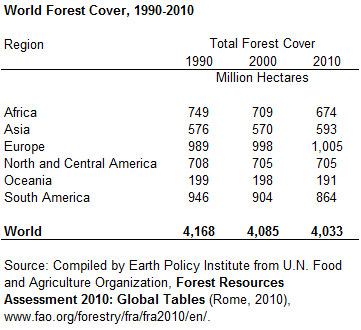
Forests cover 31 percent of the world’s land surface, just over 4 billion hectares. (One hectare = 2.47 acres.) This is down from the pre-industrial area of 5.9 billion hectares. According to data from the U.N. Food and Agriculture Organization, deforestation was at its highest rate in the 1990s, when each year the world lost on average 16 million hectares of forest—roughly the size of the state of Michigan. At the same time, forest area expanded in some places, either through planting or natural processes, bringing the global net loss of forest to 8.3 million hectares per year. In the first decade of this century, the rate of deforestation was slightly lower, but still, a disturbingly high 13 million hectares were destroyed annually. As forest expansion remained stable, the global net forest loss between 2000 and 2010 was 5.2 million hectares per year.

Global rates of deforestation do not capture the full damage done to the world’s forests. Forest degradation from selective logging, road construction, climate change, and other means compromises the health of remaining forests. Each year the world has less forested area, and the forests that remain are of lower quality. For example, replacing natural old-growth forests with a monoculture of an exotic species greatly reduces biodiversity.

The spread of planted forests has been accelerating, rising from an expansion of 3.7 million hectares annually in the 1990s to 4.9 million hectares annually the following decade. Planted forests now cover some 264 million hectares, comprising nearly 7 percent of total forest area. Plantations now have the potential to produce an estimated 1.2 billion cubic meters of industrial wood each year, about two thirds of current global wood production. Where forests have already been cleared, plantations can alleviate the pressure on standing forests.

Forests are primarily threatened by land clearing for agriculture and pasture and by harvesting wood for fuel or industrial uses. In Brazil—which has lost 55 million hectares since 1990, an area three fourths the size of Texas—land clearing for farms and ranches is the big driver. Home to the Amazon rainforest, Brazil contains 13 percent of the world’s forested area, second only to Russia’s 20 percent. Between 2000 and 2010, Brazil lost 2.6 million hectares of forest each year, more than any other country. Brazil is trying to reduce deforestation rates 80 percent from the 1996–2005 average by 2020 and has in fact seen a large drop in deforestation in recent years. But rising beef, corn, and soybean prices are likely to pressure the government to weaken its forest protection, further threatening the world’s largest rainforest. More


Thursday, August 30, 2012

World Bank issues hunger warning after droughts in US and Europe

The World Bank issued a global hunger warning last night after severe droughts in the US and eastern Europe sent food prices to a record high.

Damage to crop harvests from exceptionally dry weather this year raised sharply the Bank's food price index taking it above its peak in early 2011.

The Washington-based bank blamed the drought in the US for the 25% price rise of maize and 17% price rise in soya beans last month, adding that a dry summer in Russia, the Ukraine and Kazakhstan lay behind the 25% jump in the cost of wheat.

"Food prices rose again sharply threatening the health and well-being of millions of people," said World Bank group president, Jim Yong Kim. "Africa and the Middle East are particularly vulnerable, but so are people in other countries where the prices of grains have gone up abruptly."

The bank said food prices overall rose by 10% between June and July to leave them 6% up on a year earlier. "We cannot allow these historic price hikes to turn into a lifetime of perils as families take their children out of school and eat less nutritious food to compensate for the high prices," said Kim. "Countries must strengthen their targeted programs to ease the pressure on the most vulnerable population, and implement the right policies." More