Showing posts with label sustainable. Show all posts

Friday, March 15, 2013

How agroforestry schemes can improve food security in developing countries

Agroforestry has multiple benefits, it's important that they are raised in food security debates so that they can reach their potential.

Agroforestry – the integration of trees and shrubs with crops and livestock systems – has strong potential in addressing problems of food insecurity in developing countries. Done well, it allows producers to make the best use of their land, can boost field crop yields, diversify income, and increase resilience to climate change.

To date, the uptake of agroforestry has been constrained partly because it has lacked a natural 'home' in policy space, but that may be changing thanks to a growing body of evidence of what it can achieve, and how to make it work. The FAO last month published a guide to advancing agroforestry on the policy agenda with case studies of best practice, and is due to hold a conference on forests and food security and nutrition in May.

"In recent years we've seen increasing interest in agroforestry as an important component of sustainable land use and development," says Douglas McGuire, team leader on the FAO's Forest Resources Management team. "The many advantages it offers are being better understood."

Much of that new understanding has come from the FAO itself and from the World Agroforestry Centre (ICRAF), which has built up a body of research on issues such as the use of particular tree varieties and how they can improve soil quality, complement specific field crops, and generate new income streams for smallholders.

For example, one of the major potential benefits of on-farm trees is their ability to replenish nutrient-depleted soil, and the results of a 12-year study by ICRAF published in September 2012 showed how the planting of a particular tree variety – Gliricidia – as a fertiliser tree alongside maize improved the stability of harvests of this staple food crop in sub-Saharan Africa.

The study, based on farming systems in Malawi and Zambia, foundGliricidia to be particularly effective at drawing nitrogen from the air and fixing it in the soil, reducing the need for large doses of manufactured nitrogen fertilisers. The leaves shed by the trees also replenish the soil, increasing its structural stability and capacity to store water.

Another fertiliser tree – Faidherbia, an indigenous African acacia – has also been found to be useful in agroforestry systems thanks partly to its unusual phenology. Faidherbia goes dormant and sheds its nitrogen-rich leaves during the early rainy season, when crops are being planted, and resumes leaf growth in the dry season. That means it fertilises crops at a useful time, but doesn't compete with them for light, nutrients or water.Several studies have found Faidherbia-maize inter-cropping to increase maize yields, by as much as 400% in one area of Malawi.

This doesn't mean that particular tree varieties should necessarily be pushed as "good" for all farming systems; rather, it's important to use the right trees in the right place. "There are often trade-offs involved, and these need to be carefully assessed and balanced, according to the objectives one is trying to achieve," says McGuire. "Soil fertility enhancement, erosion control, food production, wood production, and shading are all factors. Systems where wood production may be a main objective might not be the most favourable to enhancing soil fertility, but that may be an acceptable trade-off under the given circumstances."

Even where certain trees can bring clear benefits, they are often a long-term investment. Resource-poor smallholders can be reluctant to allocate land to trees when it might take years to reap the rewards. But depending on the objectives, certain varieties or planting techniques can speed things up.

"Calliandra and leucaena are two leguminous trees which are known to deliver relatively quick pay offs for use as fodder for livestock," says Frank Place, impact assessment adviser at ICRAF and co-editor of the FAO guide. More

 

Thursday, December 20, 2012

Curbing Tanzania’s “Land Grabbing Race”

DAR ES SALAAM, Dec 19 2012 (IPS) – From January 2013, Tanzania will start restricting the size of land that single large-scale foreign and local investors can “lease” for agricultural use. The decision follows both local and international criticism that major investors are grabbing large chunks of land here, often displacing small-scale farmers and local communities.

The Permanent Secretary in the Prime Minister’s Office Peniel Lyimo confirmed that the government would limit the amount of land leased to investors in this East African nation. Previously, there were no limits.

“For a large-scale investor who wants to invest in sugar, the ceiling has been put at 10,000 hectares. (The limit for) rice is 5,000 hectares. The ceiling for sugar is significantly higher due to the fact that it may also produce electric power,” Lyimo told IPS. Sugarcane fibre is used in the generation of electricity.

According to official documents, seen by IPS, from the Tanzania Investment Centre, a government agency set up to promote and facilitate investment: “Even within a seven-year period, an investor would not be able to use more than 10,000 hectares…”

The move will come as a relief to land rights organisations that have continually called for the government to curb the land grabs here. [related_articles]

In 2008 the Tanzanian government launched the Kilimo Kwanza (Agriculture First) initiative in order to increase private sector investments in agriculture.

And when the World Economic Forum took place in Dar es Salaam in 2010, the Southern Agricultural Growth Corridor of Tanzania (SAGCOT), a multi-stakeholder partnership to rapidly develop the country’s agricultural potential, was formed and the government began to invite foreign companies to invest in crops like sugarcane, maize, rice and cassava.

However, civil society organisations like the Tanzanian NGO Land Rights Research and Resources Institute (LARRRI) and the Oakland Institute, an independent policy think tank in the United States, called on the government to review its investment policy to limit the amount of land given to foreign investors.

“Giving tens of thousands of hectares to large-scale investors was hurting small-scale farmers,” said LARRRI executive director Yefred Myenzi.

To date, he told IPS, the government has given 80,000 hectares of land to large-scale investors.

“Land conflicts pitting poor villagers against powerful investors now number more than 1,000 reported incidents. On average, there are five land disputes daily in the country and three of these involve powerful investors,” said Myenzi.

In Tanzania’s northern Loliondo district, which is known for its wildlife, much of the land has been leased out to international hunting concessions, which has resulted in the large-scale eviction of the local population – although the government refutes this. A major U.S. energy company, AgriSol Energy, has also been accused of engaging in land grabs in Tanzania that would displace more than 160,000 Burundian refugees, according to a report by the Oakland Institute. The report states that AgriSol is benefiting from the forcible eviction of the refugees, many of whom are subsistence farmers, and leasing the land — as much as 800,000 acres — from the Tanzanian government for 25 cents per acre.

Myenzi said that of the 1,825 general land disputes reported in 2011, 1,095 involved powerful investors. More


Tuesday, October 23, 2012

Nature's matrix: Linking agriculture, conservation and food sovereignty

An important book argues that conservationists who focus on creating nature preserves are undermining their own cause.

To truly protect biodiversity, environmentalists must support the global struggle of peasant farmers for human rights, land, and sustainable agriculture.

Linking Agriculture, Conservation and Food Sovereignty by Ivette Perfecto, John Vandermeer and Angus Wright

In any discussion of biodiversity and species extinction, someone insists that overpopulation is the problem. More people equals more farms equals less wilderness equals more extinctions. Life is a zero-sum game: you can have people and farming OR wildlife and biodiversity, but not both.

For a convincing antidote to such views, I highly recommend Nature’s Matrix, an important book by ecologists Ivette Perfecto, John Vandermeer and Angus Wright. Drawing on their extensive practical experience with conservation and agriculture in Central America and the Amazon, combined with recent research in ecology and agronomy, they propose a radical “new paradigm” for conservation, a strategy based on powerful evidence that preserving biodiversity is inseparable from the growing struggle of peasant farmers for human rights, land, and sustainable agriculture.

The issue is not how many people there are, but what the people do: some forms of agriculture destroy life, others preserve and expand it. Only by strengthening the social forces that support biodiversity-friendly farming can we hope to slow or reverse what’s being called the Sixth Extinction, a global species annihilation comparable to the death of the dinosaurs.

A doomed strategy

The orthodox approach to protecting biodiversity was expressed recently by David Attenborough, the well-known broadcaster and naturalist who is also a patron of the UK-based World Land Trust. In a letterto WLT supporters, Attenborough wrote:

“On the reserves purchased through donations to the Trust, which are expertly managed by its overseas partners, permanent protection is in place. Buying land for conservation is the most direct and certain road to conservation and in doing so WLT is ensuring that at least some of our wilderness, and its biodiversity, survives.”

Most conservation groups follow that approach: they try to protect biodiversity and limit species extinctions by creating wilderness reserves where human activity is limited or banned. Often they literally erect fences and pay armed guards to prevent intrusions, even by people whose ancestors lived on the land for millennia. What happens outside the reserves is only relevant if it threatens to impinge on the pristine environment where nature is protected from people.

Nature’s Matrix argues convincingly that such a focus on creating protected areas is a doomed strategythat actually harms biodiversity, increasing the likelihood of extinctions.

This is so for three reasons.

First, most tropical landscapes are not exclusively untouched or exclusively farmed. The most common pattern is a complex matrix with fragments of forest separated by a variety of farms, as this aerial photograph illustrates. More


Friday, August 31, 2012

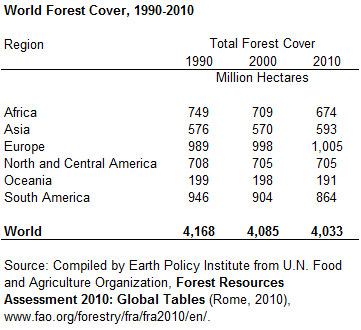
World Forest Area Still on the Decline

Forests provide many important goods, such as timber and paper. They also supply essential services—for example, they filter water, control water runoff, protect soil, regulate climate, cycle and store nutrients, and provide habitat for countless animal species and space for recreation.

Forests cover 31 percent of the world’s land surface, just over 4 billion hectares. (One hectare = 2.47 acres.) This is down from the pre-industrial area of 5.9 billion hectares. According to data from the U.N. Food and Agriculture Organization, deforestation was at its highest rate in the 1990s, when each year the world lost on average 16 million hectares of forest—roughly the size of the state of Michigan. At the same time, forest area expanded in some places, either through planting or natural processes, bringing the global net loss of forest to 8.3 million hectares per year. In the first decade of this century, the rate of deforestation was slightly lower, but still, a disturbingly high 13 million hectares were destroyed annually. As forest expansion remained stable, the global net forest loss between 2000 and 2010 was 5.2 million hectares per year.

Global rates of deforestation do not capture the full damage done to the world’s forests. Forest degradation from selective logging, road construction, climate change, and other means compromises the health of remaining forests. Each year the world has less forested area, and the forests that remain are of lower quality. For example, replacing natural old-growth forests with a monoculture of an exotic species greatly reduces biodiversity.

The spread of planted forests has been accelerating, rising from an expansion of 3.7 million hectares annually in the 1990s to 4.9 million hectares annually the following decade. Planted forests now cover some 264 million hectares, comprising nearly 7 percent of total forest area. Plantations now have the potential to produce an estimated 1.2 billion cubic meters of industrial wood each year, about two thirds of current global wood production. Where forests have already been cleared, plantations can alleviate the pressure on standing forests.

Forests are primarily threatened by land clearing for agriculture and pasture and by harvesting wood for fuel or industrial uses. In Brazil—which has lost 55 million hectares since 1990, an area three fourths the size of Texas—land clearing for farms and ranches is the big driver. Home to the Amazon rainforest, Brazil contains 13 percent of the world’s forested area, second only to Russia’s 20 percent. Between 2000 and 2010, Brazil lost 2.6 million hectares of forest each year, more than any other country. Brazil is trying to reduce deforestation rates 80 percent from the 1996–2005 average by 2020 and has in fact seen a large drop in deforestation in recent years. But rising beef, corn, and soybean prices are likely to pressure the government to weaken its forest protection, further threatening the world’s largest rainforest. More