Showing posts with label indigenous. Show all posts

Monday, September 23, 2013

International Experts Discuss Opportunities for Securing Local Community Land Rights

20 September 2013: The conference on 'Scaling-Up Strategies to Secure Community Land and Resource Rights: An International Conference to Take Stock of Current Efforts, Identify Promising Strategies, and Catalyze New Alliances and Action' concluded with participants from across 40 countries calling for a doubling of the amount of secured community land over the next five years.


The conference, which was took place from 19-20 September 2013, in Interlaken, Switzerland, brought together over 180 participants representing governments, local communities, Indigenous Peoples' organizations, private investors, food and resource companies, and conservation organizations, all of which have a common interest in clarifying and securing the ownership of community lands and resources.


The event aimed to raise the profile and prioritization of community land rights as a global concern, catalyze new ideas and alliances, and secure commitments to take these strategies forward in the coming months and years. Participants met in plenary and in strategy sessions to discuss themes related to: securing community land and resource rights; mapping and documenting; improving legal recognition and empowerment; expanding and leveraging private sector interests in securing community land rights; making community land rights a global priority; and deepening synergies between community land and resource rights and conservation efforts.


The main priorities that emerged from the sessions, as well as opportunities for scaling up existing opportunities and recommended next steps, included: starting the restitution of indigenous lands from conservation areas; striving to reach the target of doubling the amount of secured community lands; improving the effectiveness of existing instruments to secure rights; using maps effectively to secure rights; and improving internal community governance.


The meeting was co-organized by the Rights and Resources Initiative (RRI), the International Union for Conservation of Nature (IUCN), the International Land Coalition (ILC), Helvetas Swiss Intercooperation and Oxfam. [Meeting Website] [IISD RS Meeting Coverage]

More:


Tuesday, March 19, 2013

Undercover sting exposes Malaysia land-grab

Allegations of corruption get louder following secret tapes showing plunder of resource-rich Sarawak province.

Mountains of Borneo Island

Long Napir, Malaysia - Plantations and logging are ravaging Malaysia's majestic Borneo region and indigenous people who have lived for centuries here say they are increasingly being uprooted from their once-pristine lands.

But as the timber and palm oil companies swarm over the rugged landscape of resplendent rivers and ancient rainforests, villagers in Long Napir in the country's biggest state Sarawak have vowed to thwart any further land-grabs.

The village is a settlement of longhouses, the traditional communal housing favoured by indigenous people in eastern Malaysia's Borneo island.

Under the Sarawak Land Law, indigenous people have rights over areas as long as they can prove they have lived in or used the lands prior to January 1, 1958.

"We have no land to farm, our rivers have become muddy, there's hardly any fish left anymore."

- Tamin Sepuluh Ribu, villager

But the surrounding ancient rainforests that are so essential to their traditional way of life is under threat because of logging and plantation companies. Over the past 30 years, Sarawak - one of the richest Malaysian states - has become one of the largest exporters of tropical timber.

Despite its wealth, profits have failed to trickle down, and the people here are some of the poorest in the country.

Long Napir villagers lay the blame for their plight squarely on one man: the state's powerful chief minister, Abdul Mahmud Taib, who is in charge of all land classification and the allocation of lucrative forestry and plantation licenses.

"He lives, the rest of us suffer," Tamin Sepuluh Ribu, a former village headman, told Al Jazeera. "We have no land to farm, our rivers have become muddy, there's hardly any fish left anymore."

'Coterie of cronies'

Global Witness, a non-governmental organisation working against environmental exploitation, has investigated and exposed the situation in remote eastern Malaysia.

An undercover Global Witness investigator posing as an investor was offered several opportunities to purchase land in Sarawak by company officials linked to Chief Minister Taib. In each instance, the land in question was occupied by indigenous communities, who have valid claims to ownership rights under Malaysian law.

Global Witness said the indigenous areas were being sold by companies with close personal or political ties to the chief minister.

Taib has held the post since 1981, and has been repeatedly accused of corruption during his nearly 32-year rule.

The US Embassy in Kuala Lumpur noted in one cable released by WikiLeaks: "Chief Minister Taib Mahmud … doles out timber-cutting permits while patrolling the underdeveloped state using 14 helicopters, and his family's companies control much of the economy."

The American cable added that, "All major contracts and a significant portion of land to be converted to palm oil plantations [including on indigenous 'customary land rights' that the state government has refused to recognize] are given to these three companies."

People in Sarawak are "fed up" with Taib's administration, "seen as only enriching his family and a small coterie of cronies", it said.
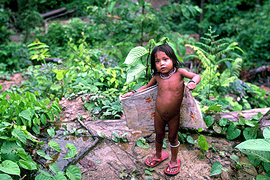
A Penan girl deep in the Borneo rainforests [EPA]

Under investigation

Global Witness released a November 2012 report titled, "In the future, there will be no forests."

"Taib's powerful executive position and personal responsibility for the issuance of lucrative logging and plantation licences has enabled him to systematically extract 'unofficial payments' from the state's timber tycoons for the enrichment of himself and his family," the report said.

Taib, meanwhile, denied the corruption allegations as "wholly untrue and malicious", said the report.

In 2011, the Malaysian Anti-Corruption Commission launched an official investigation into Taib, which continues at present.

In secretly taped negotiations provided to Al Jazeera, the Global Witness investigator discussed buying land with company shareholders Fatimah Abdul Rahman and Norlia Abdul Rahman - Taib's first cousins. Fatimah admitted the parcel of land under discussion had been transferred to them by Chief Minister Taib.

"Yeah, he's the one who gave us the land. He's my cousin," Fatimah said, laughing.

In 2011, Taib gave his cousins 5,000 hectares of land for about $300,000 dollars, according to leaked land registry documents. Having secured agriculture and timber licences, they were trying to sell it a year later for more than $16mn.

Later, discussing the ease of receiving a forestry license, Fatimah told the Global Witness investigator: "The Land and Survey Department, they are the ones that issue this licence. Of course, this is from the CM's [Chief Minister's] directive, but I can speak to the CM very easily." More


Tuesday, March 12, 2013

Land Grabs Spread Throughout Developing World

Food Justice advocates have always argued that trade agreements need to respect and promote human rights, not drive a process of globalization that privileges commercial interests and tramples on public interests. In my new paper on land grabs from the Institute for Agriculture and Trade Policy, that position is affirmed.

“Land grabs” are large-scale purchases or leases of agricultural or forested land on terms that violate the rights of the people who live on or near that land. The problem has commanded enormous public policy and media attention for the last few years. In our paper, IATP sets some context for the land grabs phenomenon. We focus on two forces that have contributed significantly to the problem:

Globalization, or the deregulation of trade and foreign investment laws, which has greatly eased cross-border capital flows; relaxed the limits on foreign land ownership; and, opened markets to agricultural imports.

The food price crisis of 2007-08, which highlighted how fragile food systems in many parts of the world have become, and which shattered the confidence of net-food importing countries in international markets as a source of food security.

The situation is compounded by climate change and the resulting destabilization of weather patterns, which in turn has made agricultural production less predictable. Climate change has made domestic food supplies less certain and exports, too. In 2012, The United States, still a huge source of grains for international markets, lost 40 percent of a record large number of acres planted with corn to drought.

The sense of food insecurity has driven some of the richer net-food importers—countries such as Saudi Arabia and Kuwait—to invest in growing food abroad for import to their domestic markets. That is one driver of land grabs.

The sense that our food systems are fragile and that supplies are scarce, where for decades they have been abundant, is another driver—companies such as South Korea’s Daewoo are looking to source raw materials directly, rather than buying them on the market.

It’s not that investment in agriculture is a bad thing. Indeed, it’s sorely needed. But unless we have the conversation about what kind of investment, in what kind of agriculture, and in whose interests, then the investment does more harm than good.

Land grabs, as the label implies, have been overwhelmingly negative. They are associated with weak institutional capacity (and sometimes corruption) in the recipient country governments, as well as authoritarian governments in the investors’ home countries, making it hard to bring pressure there for better practices. The communities whose land is leased or bought are not adequately protected.

IATP proposes four linked policy shifts to create a more stable and transparent international food system:

1) Reformed trade rules that ensure export restrictions in times of crisis are subject to transparency and predictability requirements and that allow all countries policy space for food security policies;

2) Publicly-managed grain reserves to dampen the effects of supply shocks;

3) Readily accessible funding for the poorest food importers, which would be triggered automatically when prices increase sharply in international markets; and

4) The development of strong national and international laws to govern investment in land, respecting the principles and guidelines set out in the Voluntary Guidelines on Land Tenure. Tanzania’s recently announced limits on how much land foreign and domestic investors can lease is a hopeful example of a national government taking the initiative to get serious about regulation. More


Saturday, February 23, 2013

Monsanto Conquest Attempt Meets Aztec Resistance

Monsanto has a map for conquering the world and Mexico is in the center of it.

For nearly two decades the transnational corporation that manufactures the pesticides used across the planet has been trying to take over the global seed market with genetically modified (GM) seed. If successful, most of the food we grow and eat would have to be purchased annually as seed from Monsanto. The mutant plants would grow up addicted to Monsanto herbicides. Local varieties would disappear, and in their place standardized, genetically modified food–doused with chemicals–would fill supermarket shelves and corner stores.

More than sixty thousand farmers and supporters from workers’ and environmental organizations marched through Mexico City on Jan. 31 to avoid this fate. It was one of the largest mobilizations to date to reject the Monsanto game plan, and it’s no coincidence that it took place in the heart of the Aztec Empire.

Olegario Carrillo, president of Mexican small farm organization UNORCA, addressed the crowd in the central plaza, “During the last 30 years, successive governments have tried to wipe us out. They’ve promoted measures to take away our lands, our water, our seeds, plant and animal varieties, traditional knowledge, markets. But we refuse to disappear.”

“For peasant farmers, GMOs represent looting and control,” he stated.

With tens of thousands of people shouting “No genetically modified corn in Mexico!” and “Monsanto get out!”, the march showed the muscle of an unusual grassroots movement to protect small farmers and consumers. It also revealed the remarkable success of decades of public education and organizing on an issue that Monsanto and other major biotech firms hoped would slide under the radar of the people most affected by it.

Monsanto–along with Pioneer, Dow and other chemical/biotech firms– has been pushing hard to take over production of the world’s third major staple crop: corn. Small farmers in the U.S. have long experienced the pressure exerted to move them out of the way. Monsanto predicts that its corn seed will be planted on 96 million acres in the United States this year. But the key to its plans to conquer the market lies south of the border.

The powerful corporation, the largest seed seller in the world, desperately wants permission for unrestricted planting of its GM corn in Mexico. If GM corn is planted in Mexico, it will accelerate the transfer of acreage and water rights from small farmers to corporate GM corn cultivation, thus transferring control of the national food supply as well. Widespread open planting of GM corn will lead to contamination of native varieties. This is a scientific fact. Mexico has already detected many native cornfields contaminated by GM corn during the period when open planting was prohibited—a strong indication of the impossibility of controlling open pollination between native and GM varieties.

This has huge implications. Mexico is the center of origin of corn, and the home of hundreds of varieties developed by indigenous communities over centuries. To lose in situ preservation of these varieties is to lose a wealth of agro-diversity that has major importance for sustainable food production, and to eventually become dependent on Monsanto and other large corporations to feed ourselves.

The Mexican government first legalized GM plantings through what has come to be known as the 2005 “Monsanto Law”, which the farmers are demanding be revoked. It then began issuing permits, first for experimental plantings. Having passed that phase, Monsanto has now requested permits to begin all-out commercial production. It has filed to sow some 700,000 hectares of genetically modified corn in the state of Sinaloa alone. More


Wednesday, February 20, 2013

'Land Grabbing': Foreign Investors Buy Up Third World Farmland

Foreign investors are buying or leasing vast amounts of farmland in Third World countries to profit from surging demand for food crops as a result of rapid population growth. "Land grabbing" amounts to a new form of colonialism that often runs counter to the interests of locals.

A number of developing nations have sold or leased much of their farmland to foreign investors. The list is led by Liberia, whose arable land is 100 percent under foreign ownership.

The process is known as "land grabbing," and it is affecting countries in Africa, South America, Asia and Eastern Europe. Around half of the farmland of the Philippines is owned by foreign investors. In Ukraine, American companies have secured over one-third of the country's farmland.

Population growth in countries like India and Brazil is driving up demand for cereal crops, and investments in farmlands offer the chance of solid returns.

In many cases, the population suffers from this new form of colonialism, and the planting of monocultures tends to sap the soil. More


Thursday, December 20, 2012

Curbing Tanzania’s “Land Grabbing Race”

DAR ES SALAAM, Dec 19 2012 (IPS) – From January 2013, Tanzania will start restricting the size of land that single large-scale foreign and local investors can “lease” for agricultural use. The decision follows both local and international criticism that major investors are grabbing large chunks of land here, often displacing small-scale farmers and local communities.

The Permanent Secretary in the Prime Minister’s Office Peniel Lyimo confirmed that the government would limit the amount of land leased to investors in this East African nation. Previously, there were no limits.

“For a large-scale investor who wants to invest in sugar, the ceiling has been put at 10,000 hectares. (The limit for) rice is 5,000 hectares. The ceiling for sugar is significantly higher due to the fact that it may also produce electric power,” Lyimo told IPS. Sugarcane fibre is used in the generation of electricity.

According to official documents, seen by IPS, from the Tanzania Investment Centre, a government agency set up to promote and facilitate investment: “Even within a seven-year period, an investor would not be able to use more than 10,000 hectares…”

The move will come as a relief to land rights organisations that have continually called for the government to curb the land grabs here. [related_articles]

In 2008 the Tanzanian government launched the Kilimo Kwanza (Agriculture First) initiative in order to increase private sector investments in agriculture.

And when the World Economic Forum took place in Dar es Salaam in 2010, the Southern Agricultural Growth Corridor of Tanzania (SAGCOT), a multi-stakeholder partnership to rapidly develop the country’s agricultural potential, was formed and the government began to invite foreign companies to invest in crops like sugarcane, maize, rice and cassava.

However, civil society organisations like the Tanzanian NGO Land Rights Research and Resources Institute (LARRRI) and the Oakland Institute, an independent policy think tank in the United States, called on the government to review its investment policy to limit the amount of land given to foreign investors.

“Giving tens of thousands of hectares to large-scale investors was hurting small-scale farmers,” said LARRRI executive director Yefred Myenzi.

To date, he told IPS, the government has given 80,000 hectares of land to large-scale investors.

“Land conflicts pitting poor villagers against powerful investors now number more than 1,000 reported incidents. On average, there are five land disputes daily in the country and three of these involve powerful investors,” said Myenzi.

In Tanzania’s northern Loliondo district, which is known for its wildlife, much of the land has been leased out to international hunting concessions, which has resulted in the large-scale eviction of the local population – although the government refutes this. A major U.S. energy company, AgriSol Energy, has also been accused of engaging in land grabs in Tanzania that would displace more than 160,000 Burundian refugees, according to a report by the Oakland Institute. The report states that AgriSol is benefiting from the forcible eviction of the refugees, many of whom are subsistence farmers, and leasing the land — as much as 800,000 acres — from the Tanzanian government for 25 cents per acre.

Myenzi said that of the 1,825 general land disputes reported in 2011, 1,095 involved powerful investors. More


Saturday, May 19, 2012

New UN-backed guidelines aim to protect rights to land, fisheries and forests

11 May 2012 – A United Nations-backed committee today endorsed a set of far-reaching global guidelines to help governments protect the rights of people, especially the poor, to own or access land, forests and fisheries.

“Giving poor and vulnerable people secure and equitable rights to access land and other natural resources is a key condition in the fight against hunger and poverty,”said the Director-General of the UN Food and Agriculture Organization (FAO), José Graziano da Silva.

“It is a historic breakthrough that countries have agreed on these first-ever global land tenure guidelines,” he added. “We now have a shared vision. It’s a starting point that will help improve the often dire situation of the hungry and poor.”

The new Voluntary Guidelines on the Responsible Governance of Tenure of Land, Fisheries and Forests in the Context of National Food Security was adopted by the Committee on World Food Security (CFS) – the leading global platform for discussions on food security issues – in Rome earlier on Friday.

Among the issues dealt with in the guidelines is the so-called ‘land-grabbing’ phenomenon, according to a news release issued by FAO. It recommends that safeguards be put in place to protect tenure rights of local people from risks that could arise from large-scale land acquisitions, and also to protect human rights, livelihoods, food security and the environment.

The guidelines also address a wide range of other issues such as recognition and protection of legitimate tenure rights, even under informal systems; best practices for registration and transfer of tenure rights; making sure that tenure administrative systems are accessible and affordable; managing expropriations and restitution of land to people who were forcibly evicted in the past; and the rights of indigenous communities. More


Saturday, May 12, 2012

Global land deal guidelines could pave way to world without hunger

New directives on access rights to land, fisheries and forests show constructive collaboration on food security is possible

The endorsement of voluntary guidelines to improve the way countries govern access rights to land, fisheries and forest resources by the Committee on World Food Security (CFS) on Friday marks a historic milestone not only for the way in which land tenure is managed, but also for international consensus-building.

The eradication of hunger depends in large measure on how people, communities and others have access to, and manage, land, fisheries and forests. Pressure on these resources, and on tenure arrangements, is increasing as new areas are cultivated to provide food for a rapidly growing population, urban areas expand, and as a result of environmental degradation, climate change and conflict. Rural landlessness is often the best predictor of poverty and hunger. Moreover, insecure tenure rights can lead to instability and conflict when competing users fight for control of these resources.

Weak governance of tenure hinders economic growth and the sustainable use of the environment. Small-scale farmers and traditional communities will not invest in improving their land, fisheries and forests if they could betaken away at any minute due to lack of recognition of customary rights, weak registration practices or corruption. In some countries, women, for example, despite doing all the farming, are denied legal recognition and protection of rights to their land plots.

The voluntary guidelines on the responsible governance of tenure of land, fisheries and forests in the context of national food security set foundations that are indispensable to resolve these issues. Responsiblegovernance of tenure enables sustainable social, economic and environmental development that can help eradicate food insecurity and poverty, and encourages responsible investment. More