Showing posts with label landless. Show all posts

Wednesday, September 18, 2013

Seeing Food As A Commons Opens Up Creative New Possibilities

What would the world look like if we began to re-conceptualize food as a commons? Jose Luis Vivero Pol of the Centre for Philosophy of Law at Catholic University of Louvain in Belgium has done just that in a recent essay, “Food as a Commons: Reframing the Narrative of the Food System.”

The piece is impressive for daring to imagine how the world’s estimated 668 million hungry people might eat, and how all of us would become healthier, if we treated more elements of the food production and distribution system as commons. Instead of managing food as a private good that can only be produced and allocated through markets, re-conceptualizing food as a commons helps us imagine “a more sustainable, fairer and farmer-centered food system,” writes Vivero Pol.

One reason that the commons reframing is so useful is that it helps us see the ubiquity of enclosures in the food system. We can begin to see the galloping privatization of farmland, water, energy and seeds. We can see the concentration of various food sectors and the higher prices and loss of consumer sovereignty that comes from oligopoly control.

Enclosure is snatching shared resources from us and preventing us from managing them to maximize access and good nutrition. This is often known these days as “resource grabbing,” as companies and national governments race to seize as many abundant, cheap natural resources as they can on an international scale. This is one reason for the many pernicious enclosures of land commons in Africa and Latin America in recent years. There is a huge exodus from traditional and indigenous lands as China, Saudi Arabia, Korea, hedge funds and others buy up natural resources. These enclosures are moving us “from diversity to uniformity, from complexity to homoegeneity, and from richness to impoverishment,” writes Vivero Pol.

Strangely, “no one has really questioned the nature of food as a private good, produced by private inputs or privately harvested in enclosed areas of the world." Yet asking such a question helps us to see why massive hunger can persist with food abundance. The ethic of “no money, no food” means that only those with sufficient "consumer demand" are entitled to food. And even then, good health is no guarantee because the industrialized food model actively promotes expensive processed foods that are either non-nutritious or actively harmful to our health, but more lucrative to companies.

It helps to remember that many aspects of food are already considered commons, notes Vivero Pol. For example, fish stocks, unpatented genetic resources, wild fruits, recipes, agricultural knowledge and food safety regulations cannot be owned and can be harvested and used by anyone or by bounded commons.

Most cultivated food, however, is generally a private good, which means that food is vulnerable to being traded, hoarded and sold for competing uses (e.g., biofuels, animal feed) if it can fetch more money. In the classic economists’ formulation, food that is privatized and commoditized can be made “excludable” and “rival,” and this in practice tends to override any moral entitlements or human rights claims over food.

This means that private control has enormous public consequences. If people go hungry because they can’t afford food, they suffer diet-related illnesses such as diabetes and heart disease. Their psychological health suffers. They may die of malnutrition. This of course has diverse economic, political and social effects that an economist would consider an unfortunate but inexorable “externality” for which buyers and sellers have no responsibility. But it is quite obvious that such are the predictable outcomes of the commoditization of food.

So how might we convert privately owned food production into more of a public good? (Vivero Pol uses “public good” and “commons” interchangeably, while acknowledging that the former term is used in economic contexts and the latter in sociological contexts. But I would suggest that the two terms should be emphatically separated to make clear that the commons has generative capacities and social grounding that a "public good" does not.)

First, we should apply the commons template to our food production system and enumerate the harms caused by enclosures. As Vivero Pol writes, these harms include: “excessive commodification of food, with high pricing, laws and private enclosure as main barriers to fully enjoying those vital resources”; irregular private land titling, land grabbing and land evictions…”; “excessive patents of life, biopiracy and patented GMOs”; “the concentration in agri-food chains in a few transnationals”; and enclosure schemes such as “the Carbon Sequestration Initiative,” the REDD+ and the Payment for Environmental Services.”

Once we regard food as a commons, we can begin to see that everybody ought to have a human right to food. “Another implication would be that food should be kept out of trade agreements dealing with pure private goods,” writes Vivero Pol. We would also need to develop an international legal framework to regulate food as a global level, and guarantee everyone a minimum amount of food as a “universal Basic Food Entitlement.” More


Tuesday, March 19, 2013

Undercover sting exposes Malaysia land-grab

Allegations of corruption get louder following secret tapes showing plunder of resource-rich Sarawak province.

Mountains of Borneo Island

Long Napir, Malaysia - Plantations and logging are ravaging Malaysia's majestic Borneo region and indigenous people who have lived for centuries here say they are increasingly being uprooted from their once-pristine lands.

But as the timber and palm oil companies swarm over the rugged landscape of resplendent rivers and ancient rainforests, villagers in Long Napir in the country's biggest state Sarawak have vowed to thwart any further land-grabs.

The village is a settlement of longhouses, the traditional communal housing favoured by indigenous people in eastern Malaysia's Borneo island.

Under the Sarawak Land Law, indigenous people have rights over areas as long as they can prove they have lived in or used the lands prior to January 1, 1958.

"We have no land to farm, our rivers have become muddy, there's hardly any fish left anymore."

- Tamin Sepuluh Ribu, villager

But the surrounding ancient rainforests that are so essential to their traditional way of life is under threat because of logging and plantation companies. Over the past 30 years, Sarawak - one of the richest Malaysian states - has become one of the largest exporters of tropical timber.

Despite its wealth, profits have failed to trickle down, and the people here are some of the poorest in the country.

Long Napir villagers lay the blame for their plight squarely on one man: the state's powerful chief minister, Abdul Mahmud Taib, who is in charge of all land classification and the allocation of lucrative forestry and plantation licenses.

"He lives, the rest of us suffer," Tamin Sepuluh Ribu, a former village headman, told Al Jazeera. "We have no land to farm, our rivers have become muddy, there's hardly any fish left anymore."

'Coterie of cronies'

Global Witness, a non-governmental organisation working against environmental exploitation, has investigated and exposed the situation in remote eastern Malaysia.

An undercover Global Witness investigator posing as an investor was offered several opportunities to purchase land in Sarawak by company officials linked to Chief Minister Taib. In each instance, the land in question was occupied by indigenous communities, who have valid claims to ownership rights under Malaysian law.

Global Witness said the indigenous areas were being sold by companies with close personal or political ties to the chief minister.

Taib has held the post since 1981, and has been repeatedly accused of corruption during his nearly 32-year rule.

The US Embassy in Kuala Lumpur noted in one cable released by WikiLeaks: "Chief Minister Taib Mahmud … doles out timber-cutting permits while patrolling the underdeveloped state using 14 helicopters, and his family's companies control much of the economy."

The American cable added that, "All major contracts and a significant portion of land to be converted to palm oil plantations [including on indigenous 'customary land rights' that the state government has refused to recognize] are given to these three companies."

People in Sarawak are "fed up" with Taib's administration, "seen as only enriching his family and a small coterie of cronies", it said.

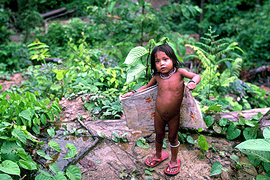
A Penan girl deep in the Borneo rainforests [EPA]

Under investigation

Global Witness released a November 2012 report titled, "In the future, there will be no forests."

"Taib's powerful executive position and personal responsibility for the issuance of lucrative logging and plantation licences has enabled him to systematically extract 'unofficial payments' from the state's timber tycoons for the enrichment of himself and his family," the report said.

Taib, meanwhile, denied the corruption allegations as "wholly untrue and malicious", said the report.

In 2011, the Malaysian Anti-Corruption Commission launched an official investigation into Taib, which continues at present.

In secretly taped negotiations provided to Al Jazeera, the Global Witness investigator discussed buying land with company shareholders Fatimah Abdul Rahman and Norlia Abdul Rahman - Taib's first cousins. Fatimah admitted the parcel of land under discussion had been transferred to them by Chief Minister Taib.

"Yeah, he's the one who gave us the land. He's my cousin," Fatimah said, laughing.

In 2011, Taib gave his cousins 5,000 hectares of land for about $300,000 dollars, according to leaked land registry documents. Having secured agriculture and timber licences, they were trying to sell it a year later for more than $16mn.

Later, discussing the ease of receiving a forestry license, Fatimah told the Global Witness investigator: "The Land and Survey Department, they are the ones that issue this licence. Of course, this is from the CM's [Chief Minister's] directive, but I can speak to the CM very easily." More


Tuesday, March 12, 2013

Land Grabs Spread Throughout Developing World

Food Justice advocates have always argued that trade agreements need to respect and promote human rights, not drive a process of globalization that privileges commercial interests and tramples on public interests. In my new paper on land grabs from the Institute for Agriculture and Trade Policy, that position is affirmed.

“Land grabs” are large-scale purchases or leases of agricultural or forested land on terms that violate the rights of the people who live on or near that land. The problem has commanded enormous public policy and media attention for the last few years. In our paper, IATP sets some context for the land grabs phenomenon. We focus on two forces that have contributed significantly to the problem:

Globalization, or the deregulation of trade and foreign investment laws, which has greatly eased cross-border capital flows; relaxed the limits on foreign land ownership; and, opened markets to agricultural imports.

The food price crisis of 2007-08, which highlighted how fragile food systems in many parts of the world have become, and which shattered the confidence of net-food importing countries in international markets as a source of food security.

The situation is compounded by climate change and the resulting destabilization of weather patterns, which in turn has made agricultural production less predictable. Climate change has made domestic food supplies less certain and exports, too. In 2012, The United States, still a huge source of grains for international markets, lost 40 percent of a record large number of acres planted with corn to drought.

The sense of food insecurity has driven some of the richer net-food importers—countries such as Saudi Arabia and Kuwait—to invest in growing food abroad for import to their domestic markets. That is one driver of land grabs.

The sense that our food systems are fragile and that supplies are scarce, where for decades they have been abundant, is another driver—companies such as South Korea’s Daewoo are looking to source raw materials directly, rather than buying them on the market.

It’s not that investment in agriculture is a bad thing. Indeed, it’s sorely needed. But unless we have the conversation about what kind of investment, in what kind of agriculture, and in whose interests, then the investment does more harm than good.

Land grabs, as the label implies, have been overwhelmingly negative. They are associated with weak institutional capacity (and sometimes corruption) in the recipient country governments, as well as authoritarian governments in the investors’ home countries, making it hard to bring pressure there for better practices. The communities whose land is leased or bought are not adequately protected.

IATP proposes four linked policy shifts to create a more stable and transparent international food system:

1) Reformed trade rules that ensure export restrictions in times of crisis are subject to transparency and predictability requirements and that allow all countries policy space for food security policies;

2) Publicly-managed grain reserves to dampen the effects of supply shocks;

3) Readily accessible funding for the poorest food importers, which would be triggered automatically when prices increase sharply in international markets; and

4) The development of strong national and international laws to govern investment in land, respecting the principles and guidelines set out in the Voluntary Guidelines on Land Tenure. Tanzania’s recently announced limits on how much land foreign and domestic investors can lease is a hopeful example of a national government taking the initiative to get serious about regulation. More


Thursday, February 14, 2013

Land Is Life, and It’s Slipping Away

PHNOM PENH, Feb 14 2013 (IPS) - Nean Narin, a humble man and father of three children, says his family is going hungry. Narin lives in the village of Boeung Kak, situated on the edge of Cambodia’s capital, Phnom Penh. For years, he and other villagers relied on the Boeung Kak Lake for fish and plants, which they would eat and sell.

Displaced families in this relocation site outside Phnom Penh

But in mid-2008, construction workers began pumping sand into the lake “in preparation for the development of a 133-hectare commercial and housing project” sponsored by Shukaku, Inc. — a Cambodian firm owned by a Senator of the ruling Cambodian People’s Party – and leased to the Chinese-owned Erdos Hong Jun Investment Co., Ltd.

Over the next four years, the project would displace over 3,000 families.

Narin and his neighbour Tep Vanny, along with a many others, refused to leave and now live a hand-to-mouth existence, stripped of a steady livelihood.

Vanny’s parents left Boeung Kak and moved to the rural Kampong Speu province, located about 48 kilometres from Phnom Penh.

But a sugar plantation tycoon has since claimed that land, and the family now faces eviction for the second time, she told IPS. All the fruit trees Vanny’s parents relied on for food have been cut down, and no compensation offered.

What was once a modest life has now become a daily struggle for survival as a result of a land buying spree in this Southeast Asian country of 14 million people, which experts say began during the 2007-2008 financial and food crisis.

"Land is life; land is dignity and without land farmers become workers for life, working as slaves for plantation owners.”

In Cambodia, land is equivalent to life: according to Germany’s federal ministry for economic cooperation and development (GTZ) over 80 percent of the population are subsistence farmers.

One of the world’s least developed countries, Cambodia seems to have no place left to go but up: over 68 percent of its people live on less than two dollars a day and 26 percent suffer from hunger on a daily basis. But the wave of land acquisitions, experienced first-hand by thousands of people like Niren and Vanny, suggests that the situation could soon get much worse.

FDI feeds landlessness

For the last two decades a wave of foreign direct investment (FDI) has had lopsided results here.

The market-driven economy – launched in 1989 and opened to foreign investors in 1993 – fuelled a rapid increase in FDI, from practically nothing in 1990 to 800 million dollars in 2008, according to the Food and Agriculture Organisation of the United Nations.

Asian countries were the largest investors from 2000 to 2010: China topped the list with 47.6 percent of FDI, making South Korea — with 18.8 percent — the second-largest investor.

While investments initially went straight into sectors like tourism (53 percent), infrastructure (21 percent) and the garments industry (20 percent), the past half-decade has seen a steady rise in land investments.

Various local and international experts attribute this spike to the global food and financial crisis of 2007 to 2008 when farmland became a valuable asset to wealthier countries outsourcing agricultural production to increase their food security, and financial speculators cashing in on land investments.

But this pattern could have catastrophic implications for millions of peasants here – already land tenure has been shrinking and 20 percent of agricultural families in Cambodia are landless. More