Want to see how severely we humans are scouring the oceans for fish? Check out this striking map fromthe World Wildlife Fund’s 2012 “Living Planet Report.” The red areas are the most intensively fished (and, in many cases, overfished) parts of the ocean — and they’ve expanded dramatically since 1950:
Between 1950 and 2006, the WWF report notes, the world’s annual fishing haul more than quadrupled, from 19 million tons to 87 million tons. New technology — from deep-sea trawling to long-lining — has helped the fishing industry harvest areas that were once inaccessible. But the growth of intensive fishing also means that larger and larger swaths of the ocean are in danger of being depleted.
Daniel Pauly, a professor of fisheries at the University of British Columbia, has dubbed this situation “The End of Fish.” He points out that in the past 50 years, the populations of many large commercial fish such as bluefin tuna and cod have utterly collapsed, in some cases shrinking more than 90 percent (see the chart to the right).
Indeed, there’s some evidence that we’ve alreadyhit “peak fish.” World fish production seems to have reached its zenith back in the 1980s, when the global catch was higher than it is today. And, according to one recent study in the journal Science, commercial fish stocks are on pace for total “collapse” by 2048 — meaning that they’ll produce less than 10 percent of their peak catch. On the other hand, many of those fish-depleted areas will be overrun by jellyfish, which is good news for anyone who enjoys a good blob sandwich. More
Food Security is defined as 'The ability of a country to produce or import enough food for normal health and physical activity of its people'.
Monday, May 21, 2012
Saturday, May 19, 2012
New UN-backed guidelines aim to protect rights to land, fisheries and forests
11 May 2012 – A United Nations-backed committee today endorsed a set of far-reaching global guidelines to help governments protect the rights of people, especially the poor, to own or access land, forests and fisheries.
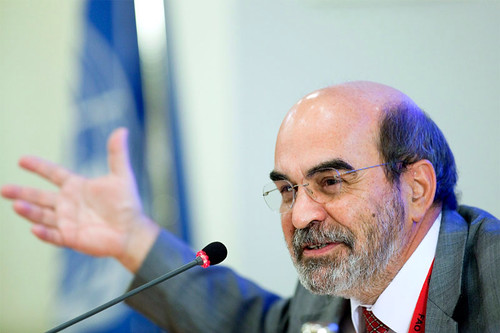
“Giving poor and vulnerable people secure and equitable rights to access land and other natural resources is a key condition in the fight against hunger and poverty,”said the Director-General of the UN Food and Agriculture Organization (FAO), José Graziano da Silva.
“It is a historic breakthrough that countries have agreed on these first-ever global land tenure guidelines,” he added. “We now have a shared vision. It’s a starting point that will help improve the often dire situation of the hungry and poor.”
The new Voluntary Guidelines on the Responsible Governance of Tenure of Land, Fisheries and Forests in the Context of National Food Security was adopted by the Committee on World Food Security (CFS) – the leading global platform for discussions on food security issues – in Rome earlier on Friday.
Among the issues dealt with in the guidelines is the so-called ‘land-grabbing’ phenomenon, according to a news release issued by FAO. It recommends that safeguards be put in place to protect tenure rights of local people from risks that could arise from large-scale land acquisitions, and also to protect human rights, livelihoods, food security and the environment.
The guidelines also address a wide range of other issues such as recognition and protection of legitimate tenure rights, even under informal systems; best practices for registration and transfer of tenure rights; making sure that tenure administrative systems are accessible and affordable; managing expropriations and restitution of land to people who were forcibly evicted in the past; and the rights of indigenous communities. More
“Giving poor and vulnerable people secure and equitable rights to access land and other natural resources is a key condition in the fight against hunger and poverty,”said the Director-General of the UN Food and Agriculture Organization (FAO), José Graziano da Silva.
“It is a historic breakthrough that countries have agreed on these first-ever global land tenure guidelines,” he added. “We now have a shared vision. It’s a starting point that will help improve the often dire situation of the hungry and poor.”
The new Voluntary Guidelines on the Responsible Governance of Tenure of Land, Fisheries and Forests in the Context of National Food Security was adopted by the Committee on World Food Security (CFS) – the leading global platform for discussions on food security issues – in Rome earlier on Friday.
Among the issues dealt with in the guidelines is the so-called ‘land-grabbing’ phenomenon, according to a news release issued by FAO. It recommends that safeguards be put in place to protect tenure rights of local people from risks that could arise from large-scale land acquisitions, and also to protect human rights, livelihoods, food security and the environment.
The guidelines also address a wide range of other issues such as recognition and protection of legitimate tenure rights, even under informal systems; best practices for registration and transfer of tenure rights; making sure that tenure administrative systems are accessible and affordable; managing expropriations and restitution of land to people who were forcibly evicted in the past; and the rights of indigenous communities. More
Labels:
human rights,
hunger,
indigenous,
land,
poor,
poverty,
rights,
tenure
Saturday, May 12, 2012
Global land deal guidelines could pave way to world without hunger
New directives on access rights to land, fisheries and forests show constructive collaboration on food security is possible
The endorsement of voluntary guidelines to improve the way countries govern access rights to land, fisheries and forest resources by the Committee on World Food Security (CFS) on Friday marks a historic milestone not only for the way in which land tenure is managed, but also for international consensus-building.
The eradication of hunger depends in large measure on how people, communities and others have access to, and manage, land, fisheries and forests. Pressure on these resources, and on tenure arrangements, is increasing as new areas are cultivated to provide food for a rapidly growing population, urban areas expand, and as a result of environmental degradation, climate change and conflict. Rural landlessness is often the best predictor of poverty and hunger. Moreover, insecure tenure rights can lead to instability and conflict when competing users fight for control of these resources.
Weak governance of tenure hinders economic growth and the sustainable use of the environment. Small-scale farmers and traditional communities will not invest in improving their land, fisheries and forests if they could betaken away at any minute due to lack of recognition of customary rights, weak registration practices or corruption. In some countries, women, for example, despite doing all the farming, are denied legal recognition and protection of rights to their land plots.
The voluntary guidelines on the responsible governance of tenure of land, fisheries and forests in the context of national food security set foundations that are indispensable to resolve these issues. Responsiblegovernance of tenure enables sustainable social, economic and environmental development that can help eradicate food insecurity and poverty, and encourages responsible investment. More
The endorsement of voluntary guidelines to improve the way countries govern access rights to land, fisheries and forest resources by the Committee on World Food Security (CFS) on Friday marks a historic milestone not only for the way in which land tenure is managed, but also for international consensus-building.
The eradication of hunger depends in large measure on how people, communities and others have access to, and manage, land, fisheries and forests. Pressure on these resources, and on tenure arrangements, is increasing as new areas are cultivated to provide food for a rapidly growing population, urban areas expand, and as a result of environmental degradation, climate change and conflict. Rural landlessness is often the best predictor of poverty and hunger. Moreover, insecure tenure rights can lead to instability and conflict when competing users fight for control of these resources.
Weak governance of tenure hinders economic growth and the sustainable use of the environment. Small-scale farmers and traditional communities will not invest in improving their land, fisheries and forests if they could betaken away at any minute due to lack of recognition of customary rights, weak registration practices or corruption. In some countries, women, for example, despite doing all the farming, are denied legal recognition and protection of rights to their land plots.
The voluntary guidelines on the responsible governance of tenure of land, fisheries and forests in the context of national food security set foundations that are indispensable to resolve these issues. Responsiblegovernance of tenure enables sustainable social, economic and environmental development that can help eradicate food insecurity and poverty, and encourages responsible investment. More
Saturday, May 5, 2012
Scientists Race to Save World's Rice Bowl From Climate Change
Climate change is predicted to cause more intense and frequent floods and droughts in Southeast Asia, threatening the world’s rice bowl and millions of people who live there unless preventive actions are taken soon, scientists warn.
At the Climate Smart Agriculture in Asia workshop held in Bangkok, Thailand, last month, climatologists and agricultural researchers discussed farming practices and technologies that could help the region cope with global warming’s effects, including rising temperatures, increased salinity, and sporadic rainfall.
The conference was about “bringing all these players together to look at how the research agenda needs to change in the agricultural research world in relation to climate change,” said Bruce Campbell of the Consultative Group on International Agricultural Research (CGIAR), which helped organize the two-day workshop.
In addition, scientists at the meeting discussed potential ways to use agriculture to mitigate the effects of climate change by reducing greenhouse gas emissions such as methane. Agriculture, forestry, and changes in land use account for a third of greenhouse gas emissions, said Campbell, who is the program director of CGIAR’s Research Program on Climate Change, Agriculture and Food Security (CCAFS).
“That’s a significant portion,” Campbell said, “but we can reduce it.”
Breaking the Breadbasket?
The countries of South and Southeast Asia are home to more than 30 percent of the world’s population, about half of whom depend on agriculture—mainly rice, but also other crops such as wheat—for their livelihoods. But according to the World Bank, global warming could reduce agricultural productivity in the region by 10 to 50 percent in the next 30 years. More
At the Climate Smart Agriculture in Asia workshop held in Bangkok, Thailand, last month, climatologists and agricultural researchers discussed farming practices and technologies that could help the region cope with global warming’s effects, including rising temperatures, increased salinity, and sporadic rainfall.
The conference was about “bringing all these players together to look at how the research agenda needs to change in the agricultural research world in relation to climate change,” said Bruce Campbell of the Consultative Group on International Agricultural Research (CGIAR), which helped organize the two-day workshop.
In addition, scientists at the meeting discussed potential ways to use agriculture to mitigate the effects of climate change by reducing greenhouse gas emissions such as methane. Agriculture, forestry, and changes in land use account for a third of greenhouse gas emissions, said Campbell, who is the program director of CGIAR’s Research Program on Climate Change, Agriculture and Food Security (CCAFS).
“That’s a significant portion,” Campbell said, “but we can reduce it.”
Breaking the Breadbasket?
The countries of South and Southeast Asia are home to more than 30 percent of the world’s population, about half of whom depend on agriculture—mainly rice, but also other crops such as wheat—for their livelihoods. But according to the World Bank, global warming could reduce agricultural productivity in the region by 10 to 50 percent in the next 30 years. More
Labels:
agriculture,
climate smart,
food,
food security
Friday, May 4, 2012
Food is the New Oil, Land is the New Gold
“Food is the new oil,” declares Lester Brown, head of the Earth Policy Institute, in an interview just published inHandshake. With tightening world food supplies, Brown discusses how food security has become one of the most pressing issues of our time – and what’s being done to assure that supply will meet the food needs of a growing world population for decades to Water – and the lack of it – complicates the issue further. With a large percentage of potable water underground, land grabs are also veiled water grabs. Brown points out that “[h]alf of us today live in countries that are over-pumping aquifers for irrigation. This is a water-based food bubble” looming on the horizon.
Brown posits that the potentially dangerous tightening of the world food situation has led to an “every country for itself” mentality and that the ability to grow food is fast becoming a new form of geopolitical leverage. Farmers are already capitalizing on all the available technologies at hand, yet it’s still not enough to meet demand, and “scientists have nothing new to give them,” Brown points out.
The result? Land grabs, whereby importing countries buy land in other countries on which to produce food for their own citizens. So while food has become the new oil, “land is the new gold,” Brown suggests.
But “it’s more than governments trying to buy or lease land, it’s an investment issue,” he says. “There are agribusiness firms and investment banks, along with pension funds and university endowments, putting parts of their investments now in land. It’s hard to see where it’s going to end.”
Water – and the lack of it – complicates the issue further. With a large percentage of potable water underground, land grabs are also veiled water grabs. Brown points out that “[h]alf of us today live in countries that are over-pumping aquifers for irrigation. This is a water-based food bubble” looming on the horizon. More
Brown posits that the potentially dangerous tightening of the world food situation has led to an “every country for itself” mentality and that the ability to grow food is fast becoming a new form of geopolitical leverage. Farmers are already capitalizing on all the available technologies at hand, yet it’s still not enough to meet demand, and “scientists have nothing new to give them,” Brown points out.
The result? Land grabs, whereby importing countries buy land in other countries on which to produce food for their own citizens. So while food has become the new oil, “land is the new gold,” Brown suggests.
But “it’s more than governments trying to buy or lease land, it’s an investment issue,” he says. “There are agribusiness firms and investment banks, along with pension funds and university endowments, putting parts of their investments now in land. It’s hard to see where it’s going to end.”
Water – and the lack of it – complicates the issue further. With a large percentage of potable water underground, land grabs are also veiled water grabs. Brown points out that “[h]alf of us today live in countries that are over-pumping aquifers for irrigation. This is a water-based food bubble” looming on the horizon. More
Labels:
food,
food security,
security,
water,
water harvesting
Wednesday, May 2, 2012
Beyond Fossilized Paradigms: Futureconomics of Food
by Vandana Shiva
New Delhi, India - The economic crisis, the ecological crisis and the food crisis are a reflection of an outmoded and fossilized economic paradigm - a paradigm that grew out of mobilizing resources for the war by creating the category of economic "growth" and is rooted in the age of oil and fossil fuels. It is fossilized both because it is obsolete, and because it is a product of the age of fossil fuels. We need to move beyond this fossilized paradigm if we are to address the economic and ecological crisis.
Economy and ecology have the same roots “oikos” - meaning home - both our planetary home, the Earth, and our home where we live our everyday lives in family and community.
But economy strayed from ecology, forgot the home and focused on the market. An artificial “production boundary” was created to measure Gross Domestic Product (GDP). The production boundary defined work and production for sustenance as non-production and non-work - “if you produce what you consume, then you don’t produce”. In one fell swoop, nature’s work in providing goods and services disappeared. The production and work of sustenance economies disappeared, the work of hundreds of millions of women disappeared.
To the false measure of growth is added a false measure of “productivity”. Productivity is output for unit input. In agriculture this should involve all outputs of biodiverse agro-ecosystems - the compost, energy and dairy products from livestock, the fuel and fodder and fruit from agroforestry and farm trees, the diverse outputs of diverse crops. When measured honestly in terms of total output, small biodiverse farms produce more and are more productive.
Bhutan has given up the false categories of GNP and GDP, and replaced them with the category of “gross national happiness” which measures the wellbeing of nature and society. More
The economics of the future is based on people and biodiversity - not fossil fuels, toxic chemicals and monocultures.
New Delhi, India - The economic crisis, the ecological crisis and the food crisis are a reflection of an outmoded and fossilized economic paradigm - a paradigm that grew out of mobilizing resources for the war by creating the category of economic "growth" and is rooted in the age of oil and fossil fuels. It is fossilized both because it is obsolete, and because it is a product of the age of fossil fuels. We need to move beyond this fossilized paradigm if we are to address the economic and ecological crisis.
Economy and ecology have the same roots “oikos” - meaning home - both our planetary home, the Earth, and our home where we live our everyday lives in family and community.
But economy strayed from ecology, forgot the home and focused on the market. An artificial “production boundary” was created to measure Gross Domestic Product (GDP). The production boundary defined work and production for sustenance as non-production and non-work - “if you produce what you consume, then you don’t produce”. In one fell swoop, nature’s work in providing goods and services disappeared. The production and work of sustenance economies disappeared, the work of hundreds of millions of women disappeared.
To the false measure of growth is added a false measure of “productivity”. Productivity is output for unit input. In agriculture this should involve all outputs of biodiverse agro-ecosystems - the compost, energy and dairy products from livestock, the fuel and fodder and fruit from agroforestry and farm trees, the diverse outputs of diverse crops. When measured honestly in terms of total output, small biodiverse farms produce more and are more productive.
Bhutan has given up the false categories of GNP and GDP, and replaced them with the category of “gross national happiness” which measures the wellbeing of nature and society. More
Virginia ruling aids Alaska climate suit
The Virginia Supreme Court has handed down an unprecedented ruling on companies’ liability for global warming-related damages — a first-in-the-nation decision that could portend massive consequences for energy companies and environmental lawyers.
The ruling stems from an ongoing case in federal court, in which the Alaskan island town of Kivalina accused a handful of mostly U.S. energy companies of contributing to global warming, which it says has rendered the town uninhabitable. One of the energy companies named in the lawsuit, Arlington-based AES Corp., was then sued in Virginia by its insurance carrier, which objected to having to defend the company and possibly pay damages associated with global warming as part of a policy covering accidents.
“In this instance, the allegations of negligence do not support a claim of an accident,” Justice S. Bernard Goodwyn wrote in a 16-page opinion issued on April 20.
Some analysts say the opinion, the first of its kind on the subject, could set policy on an emerging issue of litigation for years to come. More
The ruling stems from an ongoing case in federal court, in which the Alaskan island town of Kivalina accused a handful of mostly U.S. energy companies of contributing to global warming, which it says has rendered the town uninhabitable. One of the energy companies named in the lawsuit, Arlington-based AES Corp., was then sued in Virginia by its insurance carrier, which objected to having to defend the company and possibly pay damages associated with global warming as part of a policy covering accidents.
“In this instance, the allegations of negligence do not support a claim of an accident,” Justice S. Bernard Goodwyn wrote in a 16-page opinion issued on April 20.
Some analysts say the opinion, the first of its kind on the subject, could set policy on an emerging issue of litigation for years to come. More
Labels:
alaska,
change,
climate,
supreme court,
united states,
virginia
Arab Grain Imports Rising Rapidly
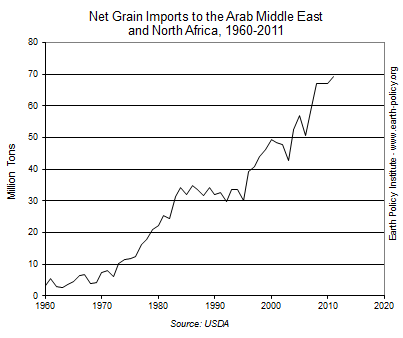
The Arab countries in the Middle East and North Africa make up only 5 percent of the world’s population, yet they take in more than 20 percent of the world’s grain exports. Imports to the region have jumped from 30 million tons of grain in 1990 to nearly 70 million tons in 2011. Now imported grain accounts for nearly 60 percent of regional grain consumption. With water scarce, arable land limited, and production stagnating, grain imports are likely to continue rising.
Egypt is the largest grain producer in the Arab world, accounting for almost 40 percent of the region’s harvest. Its grain production has doubled over the last 20 years. But because nearly all of the country’s available freshwater and arable land is already used for agriculture, further expansion of the grain harvest is unlikely.
In the 1980s, Saudi Arabia began pumping fossil water from deep underground, allowing it to farm the desert. By subsidizing wheat production at several times the world price, Saudi Arabia became the second largest Arab wheat producer in the early 1990s. At its peak, Saudi Arabia harvested more than twice the wheat it consumed, exporting the excess. But with the underground water supplies nearly depleted, wheat production has plummeted. By 2016, Saudi Arabia plans to phase out wheat production entirely. In a span of 25 years, the country will have gone from exporting wheat to relying exclusively on imports. More
Egypt is the largest grain producer in the Arab world, accounting for almost 40 percent of the region’s harvest. Its grain production has doubled over the last 20 years. But because nearly all of the country’s available freshwater and arable land is already used for agriculture, further expansion of the grain harvest is unlikely.
In the 1980s, Saudi Arabia began pumping fossil water from deep underground, allowing it to farm the desert. By subsidizing wheat production at several times the world price, Saudi Arabia became the second largest Arab wheat producer in the early 1990s. At its peak, Saudi Arabia harvested more than twice the wheat it consumed, exporting the excess. But with the underground water supplies nearly depleted, wheat production has plummeted. By 2016, Saudi Arabia plans to phase out wheat production entirely. In a span of 25 years, the country will have gone from exporting wheat to relying exclusively on imports. More
Labels:
food,
food security,
middle east
The end to cheap oil: a threat to food security and an incentive to reduce fossil fuels in agriculture
Why is this issue important?
Fossil fuels are essential for modern, mechanized agricultural production systems. Petroleum products are used directly to power tractors, machinery and irrigation, and to transport, transform and package agricultural products. They are also used indirectly to manufacture fertilizers and pesticides and prepare seeds. Thus, food production is energy intensive. For example, approximately 2 000 litres per year in oil equivalents are required to supply food for each American, which accounts for about 19 per cent of the total energy used in the United States (Pimentel and others 2008).
The industrialization of agriculture, known as the Green Revolution, occurred during the middle of the 20th century, as farming became increasingly dependent on direct and indirect fossil fuel inputs (Wood and others 2010). Between 1945 and 1994, agricultural energy inputs worldwide increased four-fold while crop yields increased three-fold. Since the early 1960s, the global growth in cereals depended almost entirely on agricultural intensification, with little expansion in the area harvested (UNEP 2011) (Figure 1).
As machines replaced farm workers, the energy output-to-input ratio declined (Figure 2) (Pfeiffer 2003). In industrialised countries today, one food calorie requires expending an average of between seven to ten calories of fossil energy (Dahlberg 2000).
While food production—not to mention transportation and many other modern systems—has become ever more dependent on oil, world oil reserves have been dwindling. The amount of oil that can be recovered cost effectively and the date at which oil production will begin to decrease is known as “peak oil”. Estimates of peak oil vary widely. In 2010, the International Energy Agency (IEA) reported that conventional oil production reached a plateau in 2006 and started declining in 2009 (IEA 2010) (Figure 3). More
Fossil fuels are essential for modern, mechanized agricultural production systems. Petroleum products are used directly to power tractors, machinery and irrigation, and to transport, transform and package agricultural products. They are also used indirectly to manufacture fertilizers and pesticides and prepare seeds. Thus, food production is energy intensive. For example, approximately 2 000 litres per year in oil equivalents are required to supply food for each American, which accounts for about 19 per cent of the total energy used in the United States (Pimentel and others 2008).
The industrialization of agriculture, known as the Green Revolution, occurred during the middle of the 20th century, as farming became increasingly dependent on direct and indirect fossil fuel inputs (Wood and others 2010). Between 1945 and 1994, agricultural energy inputs worldwide increased four-fold while crop yields increased three-fold. Since the early 1960s, the global growth in cereals depended almost entirely on agricultural intensification, with little expansion in the area harvested (UNEP 2011) (Figure 1).
As machines replaced farm workers, the energy output-to-input ratio declined (Figure 2) (Pfeiffer 2003). In industrialised countries today, one food calorie requires expending an average of between seven to ten calories of fossil energy (Dahlberg 2000).
While food production—not to mention transportation and many other modern systems—has become ever more dependent on oil, world oil reserves have been dwindling. The amount of oil that can be recovered cost effectively and the date at which oil production will begin to decrease is known as “peak oil”. Estimates of peak oil vary widely. In 2010, the International Energy Agency (IEA) reported that conventional oil production reached a plateau in 2006 and started declining in 2009 (IEA 2010) (Figure 3). More
Thursday, April 26, 2012
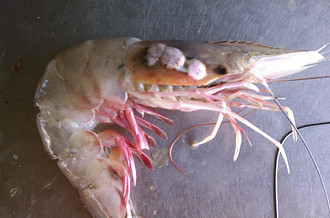
Gulf Waters Closed To Shrimping
The Alabama Department of Conservation and Natural Resources acted this week to close waters along the Gulf Coast to shrimping due to [EDIT: amidst] widespread reports from scientists and fishermen of deformed seafood and drastic fall-offs in populations two years after the BP oil spill. [‘Official’ reason is now reported to be smaller than average shrimp.]
All waters in the Mississippi Sound and Mobile Bay, and some areas of Bon Secour, Wolf Bay and Little Lagoon were closed to shrimpers. Reports of grossly deformed seafood all along the Gulf from Louisiana to the Florida panhandle have been logged with increasing urgency, but Alabama is the first state to actually close waters to the seafood industry.“We’re continuing to pull up oil in our nets. People who live here know better than to swim in or eat what comes out of our waters.”
And it’s not just the shrimp. Commercial fishermen are reporting red snapper and grouper riddled with deep lesions and covered with strange black streaks. Highly underdeveloped blue crabs are being pulled up in traps without eyes and claws…Commercial fishers Tracy Kuhns and Mike Roberts from Barataria, LA reported to Al Jazeera when showing samples of eyeless shrimp…
“At the height of the last white shrimp season, in September, one of our friends caught 400 pounds of these. Disturbingly, not only do the shrimp lack eyes, they even lack eye sockets.”And there’s no question that the leftover mess from BP’s disaster can affect human health. The dispersants BP used to ‘hide’ the extent of their blow-out contain solvents that are notoriously toxic to people and include known mutagens. Pathways of human exposure include inhalation, skin and eye contact as well as ingestion, and exposure causes headaches, vomiting, diarrhea, abdominal pain, chest pain, respiratory system damage, skin sensitization, hypertension, CNS depression, neurotoxic effects, cardiac arrhythmia and cardiovascular damage. They also cause fetal deformities and cancer. More
Labels:
bp,
food security,
gulf of mexico,
seafood
Subscribe to:
Posts (Atom)