Thursday, April 26, 2012

Save the Bees -Avaaz

Posted: 24 April 2012

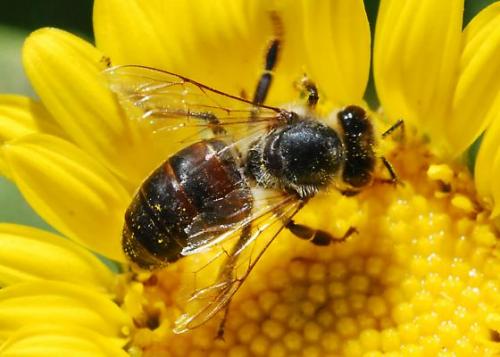
Quietly, globally, billions of bees are dying, threatening our crops and food. But if Bayer stops selling one group of pesticides, we could save bees from extinction.

Four European countries have begun banning these poisons, and some bee populations are already recovering. But Bayer, the largest producer of neonicotinoids, has lobbied hard to keep them on the market. Now, massive global pressure from Avaaz and others has forced them to consider the facts, and in 24 hours, Bayer shareholders will vote on a motion that could stop these toxic chemicals. Let’s all act now and shame the shareholders to stop killing bees.

The pressure is working, and this is our best chance to save the bees. Sign the urgent petition and send this to everyone -- let's reach half a million signers and deliver it directly to shareholders tomorrow in Germany! Click Here


Wednesday, April 25, 2012

South Africa’s Smallholders Lose Battle for Seed Security

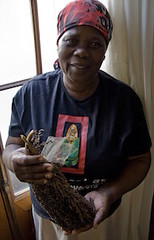
CAPE TOWN, South Africa, Apr 23, 2012 (IPS) - In an almost ceremonial manner, Selinah Mncwango opens her big plastic bag and pulls out several smaller packets, each filled with different types of seeds: sorghum, bean, pumpkin, and maize. They are her pride, her wealth, the "pillar of my family," says the farmer from a village in South Africa’s KwaZulu-Natal province.

Sixty-five-year-old Mncwango comes from a family of smallholder farmers in the village of Ingwawuma in the east coast province. The crops she grows today are from seeds that have been handed down from generation to generation, over decades, she says. Other seeds come from exchanges with neighbouring farmers. "My seeds are very important to me. I hope the day will never come when I have to buy seeds from a shop," says the farmer, whose five children and eight grandchildren largely depend on her harvest. She is keenly aware of the fact that seed saving, storing and exchanging promotes crop diversity, saves money and provides smallholder farmers with a safety net in case of harvest failures.

But the traditional farming methods of smallholder farmers – which, researchers say, also help to fight soil depletion, reduce irrigation needs and adapt to climate change – may soon disappear. They are being wiped out by governments focused on promoting commercial monocultures that they hope will bring fast, high yields in order to boost national agricultural sales on global markets.

"The sector is dominated by commercial seed companies and industrial agricultural production," explains Rachel Wynberg, policy analyst at the Environmental Evaluation Unit of the University of Cape Town in South Africa. Small-scale farmers have been systematically pushed out of the system by those who put profits before food security and biodiversity, she says.

"There is a poor understanding of small farmers’ rights. Traditional agricultural practices have thus been eroded over decades," she adds.

In South Africa, and in most other countries on the continent, the rights of small-scale farmers are regularly violated by governments and commercial entities that push genetically modified (GM) and hybrid seeds – which have been cross-pollinated in controlled environments – on them. More


Wednesday, April 18, 2012

It's almost two years since BP's oil spill in the Gulf of Mexico. Now, scientists say they have found deformities among seafood and a great decline in the numbers of marine life. Dahr Jamail reports from New Orleans.

It's almost two years since BP's oil spill in the Gulf of Mexico. Now, scientists say they have found deformities among seafood and a great decline in the numbers of marine life. Dahr Jamail reports from New Orleans.

Sunday, April 15, 2012

Will Permaculture become the new dominant narrative?

The dominant narrative of our culture is that economic growth can continue indefinitely but the realities of resource depletion, peak oil and ecosystem collapse mean this is wishful thinking. Cameron Leckie explains that if permaculture becomes the new dominant narrative, it will ensure that the changes that will eventually be forced upon us will be empowering rather than authoritarian or dictatorial.

Narratives define our society. Pick any significant issue and it is the narrative, rather than the 'facts,' which define it. Narratives have been part of the human experience for millennia and no doubt will continue to do so for millennia to come. They drive how we view the world, the way we live and the decisions that we make.

Narratives do not necessarily reflect reality. Rather they offer a version of reality which suits the group or groups of people that believe in the narrative (or want you to believe). Examples include religious or other groups which try to convince others that the end of the world is nigh but that the true believers will be saved and the cargo cults of the Pacific who believed that a combination of magic and religious rituals would result in more cargo/material goods arriving.

Narratives change over time. Change occurs as societies develop new understandings or differing groups within a society attempt to convince others of a particular narrative. Over time a dominant narrative tends to form. This does not happen by accident but is both perpetuated and strengthened through culture, media institutions, politicians and society at large. More


Friday, April 13, 2012

Millions Against Monsanto: The Food Fight of Our Lives

Finally, public opinion around the biotech industry's contamination of our food supply and destruction of our environment has reached the tipping point. We're fighting back.

"If you put a label on genetically engineered food you might as well put a skull and crossbones on it." -- Norman Braksick, president of Asgrow Seed Co., a subsidiary of Monsanto, quoted in the Kansas City Star, March 7, 1994

"Monsanto should not have to vouchsafe the safety of biotech food. Our interest is in selling as much of it as possible. Assuring its safety is the FDA's job." -- Phil Angell, Monsanto's director of corporate communications, quoted in the New York Times, October 25, 1998

For nearly two decades, Monsanto and corporate agribusiness have exercised near-dictatorial control over American agriculture, aided and abetted by indentured politicians and regulatory agencies, supermarket chains, giant food processors, and the so-called “natural” products industry.

Finally, public opinion around the biotech industry’s contamination of our food supply and destruction of our environment has reached the tipping point. We’re fighting back.

This November, in a food fight that will largely determine the future of what we eat and what we grow, Monsanto will face its greatest challenge to date: a statewide citizens’ ballot initiative that will give Californians the opportunity to vote for their right to know whether the food they buy is contaminated with GMOs. More


Tuesday, April 3, 2012

How Coral Bleaching Could Lead to Famine

The effects of climate change, such as coral bleaching, become slow-motion disasters, with knock-on effects for years.

Between March and July of that year, a rare climatological double whammy sent ocean temperatures spiking 1 to 2 degrees Celsius above the normal range for spring and summer. An unusually intense El NiƱo weather pattern coincided with the warm phase of another cyclical area weather event. This turned out to be a slow-motion disaster. Half the corals in the region bleached and died that year. Some had a 90 percent loss. "The bleaching and mortality event took about six months to fully unfold, but many of the reefs have not recovered even today -- 14 years after the event," said McClanahan, an employee of the Wildlife Conservation Society. He has spent more than 20 years working along Kenya's southeastern coast.

For Tim McClanahan, a zoologist studying fisheries, what happened in Kenya during the spring of 1998 was a wake-up call.

It took four years before scientists could definitively show dramatic declines in three commonly caught species of food fish. The lag and the devastating results got McClanahan thinking about climate change's potential to damage the economies of communities that traditionally rely on fish to eat and fish to sell. He's not alone in pondering the fate of the world's fisheries in a changing climate, and how the fortunes of fish will affect the lives and livelihoods of more than 1.5 billion people who depend on seafood for at least a fifth of the animal protein they consume. More


Tuesday, March 20, 2012

Food Security in a Climate-Altered Future (Part 1)

“Hotspots” Suggest Food Insecurity More Than a Supply Problem

Small talk about the weather with my Malawian taxi driver became serious very quickly. “We no longer know when the rains are coming,” he said as we bumped along the road toward the Lilongwe airport last November. “It is very difficult, because we don’t know when to plant.”

These days, he is grateful for his job driving a taxi. His extended family and friends are among the 85 percent of Malawians employed in agriculture, much of which is small-holder, rain-fed subsistence farming. Weather-related farming challenges contribute to ongoing food insecurity in Malawi, where one in five children is undernourished.

His observations of the recent changes in climate match forecasts for the region: in East Africa, climate change is expected to reduce the productivity of maize – Malawi’s main subsistence crop – by more than 20 percent by 2030, according to a recent analysis by Oxfam International.

I looked out the window at dusty fields and tried to imagine what Malawi might look like in 2030. For one thing, it will be more crowded. A lot more crowded. According to UN population projections, by 2030, Malawi’s population will have grown from about 15 million today to somewhere between 26.9 and 28.4 million. With climate change dampening agricultural productivity and population growth increasing food demand, how will Malawians – many of whom don’t have enough to eat now – have enough to eat in the future?

It gets quiet in the taxi as the driver and I both ponder this question. Malawi is not alone in being a climate-vulnerable country with a rapidly growing population dependent on rain-fed agriculture. Population Action International’s Mapping Population and Climate Change tool shows us that many “hotspot” countries – scattered across Latin America, Africa, and Asia – face the triple challenge of low climate change resilience, projected decline in agricultural productivity, and rapid population growth.

Agricultural trade, government safety net programs, and foreign assistance will no doubt continue to play an important role in the quest for food security in Malawi and other “hotspot” countries in the future. And climate change adaptation projects will, hopefully, reshape agricultural practices and technologies in ways that can boost yields and enable crops to better withstand temperature and precipitation fluctuations.

These interventions will be critical in addressing the supply side of future food security challenges. But what about growing demand?

Malthus Revisited?

Juxtaposing population growth with food production does, of course, bring us back to Thomas Robert Malthus’ original (and by now somewhat infamous) dire warning: that population growth would eventually outrun food supply. But seeing the scale of the challenges in Malawi firsthand, I must admit that my inner Malthus sat up and took notice.

It is true that technological advances have enabled astounding growth in agricultural yields that have enabled us to feed the world in ways the doom-filled Malthus could never have imagined in the early 19th century. But it is also true that the agricultural productivity gains that helped us keep pace with population growth for so long are beginning to slow: According to the U.S. Department of Agriculture, aggregate agricultural yields averaged 2.0 percent growth annually between 1970 and 1990, but that growth in yields declined to 1.1 percent between 1990 and 2007, and is projected to decline to less than 1.0 percent in the years to come. More


Monday, March 19, 2012

Water and Food Facts for World Water Day

March 22 is World Water Day, and its theme this year—water and food security—couldn’t be more pressing. But what do we really know about water—where it goes, what it’s used for, and how to preserve it? Here are a few water facts to get people thinking about what the “food and water crisis” really means, and how we can begin to change things.

Consumption

India, China and the United States together account for about one-third of the water extracted each year globally.

Over 90 percent of the water consumed globally by humans is used for agriculture.

Irrigation and Groundwater

Only 16 percent of world’s cropland is irrigated. But because irrigated land is more than twice as productive, that land accounts for 36 percent of the food we harvest.

To meet the constant demand for irrigation, countries are increasingly using more and more non-renewable groundwater. According to the United Nations, groundwater extraction has tripled in the last half century. India and China’s use of groundwater grew the most – today these countries use ten times as much groundwater as they did in 1950.

The amount of groundwater the world uses is so huge, it’s contributing to rising sea levels – as much as 25 percent of the observed amount in recent years. That means that an enormous amounts of water drawn from underground aquifers is never replaced. Or as Duke University’s Bill Chameides puts it, “Mankind is moving buckets and buckets of water from land to the ocean.”

The amount of groundwater the world uses is so huge that it’s also changing local climates, and it may bemasking the effects of global warming, according to research published in Climate Dynamics. This masking effect is most striking over North America, India, the Middle East and East Asia.

Pumping groundwater consumes enormous amounts of energy. In India, approximately one-fifth of the nation’s total electricity consumption goes toward pumping groundwater for irrigation. In the most important food producing areas, that number is much higher.

Virtual Water

Almost everything we do—from growing food, to making clothes and computers and automobiles, to generating electricity requires water. “Virtual water” refers to the amount of water it takes to produce and transport a commodity. Check your own water footprint here.

Many water-stressed nations are today virtual water exporters. India is the largest net exporter of virtual water.

Climate Change and the Future

According to the OECD, by 2030 almost half of the world’s population will be living under severe water stress.

Globally, heat waves and extreme drought could increase under climate change. The impact will be worse in some areas. According to research by Lamont-Doherty scientists at the Earth Institute, by mid-century dustbowl conditions seen in the 1930s will become the new norm for the southwestern United States.

Water stress threatens the grid. Conventional powerplants – hydroelectric, coal-fired, gas fired and nuclear—require tremendous volumes of water to run, accounting for 50 percent of water withdrawals in the United States. According to a study for the Columbia Journal of Environmental Law, the convergence of population growth, rising demand and drought could cause huge water shortages and force powerplant shutdowns.

What You Can Do

Think about diet. The amount of water it takes to produce different kinds of food various tremendously. The water footprint of beef is particularly egregious, consuming anywhere from 2500 to 5000 gallons of water per pound. Consider cutting back, or switching to grass-fed beef, which has a significantly lower water footprint. More


Thursday, March 8, 2012

Permaculture Resiliency Project with the San Bushmen in the Kalahari

In a land of contrast, mystery and years of imperialism, a small village of over 300 people on the edge of the Kalahari in Namibia germinated a new permaculture resiliency project in January of 2012. In talking with the headman of the village, he shared that their people, the San Bushmen, have lived in harmony with the land as hunter gatherers for eons. They are often cited as the first peoples of Africa and very likely all of humanity may have descended from their ranks many millennia ago.

The village elder sadly shared that colonialism has destroyed the San migratory way of life — a hunter gatherer tradition that was sustainable for thousands of years. He told us that they were no longer allowed to roam freely and trophy hunters destroyed the vast herds of game that formed their principal supply of food. Both Black and White farmers alike built up huge herds of cattle that destroyed the ecology of the Kalahari and subsequently the foods that had been their staple diet. They soon found they had to work for the farmers to be able to feed their families and hence a cycle of poverty and separation from their cultural roots ensued.

Although rarely recognized in the histories of the west, a similar unfolding of separation from our ancestral sustainable way of living has been a part of all our stories at some point in our history. Somewhere deep in our bones we can truly empathize with the plight of these people. The village of Vergenoeg came to be out of the displacement of the San and that of the Damara peoples who eventually had to settle to survive. You can see and feel the the years of gathered grief that are evident in the very fabric of the village in both prominent and subtle ways. Yet, there are vast cultural roots that keep the people cohesive in their plight for a sustainable future.

Seven years ago an inspired Canadian named Kimberly Cornish visited the village, fell in love with the land and the people, and felt that she could eventually facilitate some positive and lasting projects to help the people remember their gifts and build their capacity and resilience — and that of the land. Ever since then she has been building her skill set and experiences to prepare her for this vision that has led up to this project. More


Sunday, February 26, 2012

Protect Your Food Security


The Food Movement Speaks With oneVoice: Occupy our Food Supply

Willie Nelson, Anna Lappe, Vandana Shiva, Michael Pollan, Raj Patel, Marion Nestle and Many Others Join 60+ Occupy Groups and 30+ Environmental and Food Groups for Global Day of Action 
Monsanto and Cargill rise to top of food movement’s ire 
SAN FRANCISCO (Thursday, February 23): On February 27, an unprecedented alliance of more than60 Occupy groups and 30 environmental, food and corporate accountability organizations have joined together for Occupy our Food Supply, a global day of action resisting the corporate control of food systems.

The call to Occupy our Food Supply, facilitated by Rainforest Action Network, is being echoed by prominent thought leaders, authors, farmers and activists including the Indian environmentalist Vandana Shiva, Food Inc.’s Robert Kenner, music legend Willie Nelson, actor Woody Harrelson, and authors Michael Pollan, Raj Patel, Anna Lappe, Gary Paul Nabhan, and Marion Nestle, among others. (See quotes in release below). The central theme uniting this diverse coalition is a shared sense of urgency to resist the corporate consolidation of food systems and create socially and environmentally just local solutions.

"Nothing is more important than the food we eat and the family farmers who grow it," said Willie Nelson, Founder and President of Farm Aid. "Corporate control of our food system has led to the loss of millions of family farmers, destruction of our soil, pollution of our water and health epidemics of obesity and diabetes. We simply cannot afford it. Our food system belongs in the hands of many family farmers, not under the control of a handful of corporations."

From Brazil, Hungary, Ireland, and Argentina to dozens of states in the US, thousands of people will be participating in the February 27 global day of action.  Participants will be reclaiming unused bank-owned lots to create community gardens; hosting seed exchanges in front of stock exchanges; labeling products on grocery store shelves that have genetically engineered ingredients; building community alliances to supportlocally owned grocery stores and resist Walmart megastores; and protesting food giants Monsanto and Cargill.

“Occupy our Food Supply is a day to reclaim our most basic life support system – our food – from corporate control. It is an unprecedented day of solidarity to create local, just solutions that steer our society away from the stranglehold of industrial food giants like Cargill and Monsanto,” said Ashley Schaeffer, Rainforest Agribusiness campaigner with Rainforest Action Network (RAN), of the day of action,

Never have so few corporations been responsible for more of our food chain. Of the 40,000 food items in a typical US grocery store, more than half are now brought to us by just 10 corporations. Today, three companies process more than 70 percent of all U.S. beef, Tyson, Cargill andJBS.[1] More than ninety percent of soybean seeds and 80 percent of corn seeds used in the United States are sold by just one company: Monsanto. Four companies are responsible for up to 90 percent of the globaltrade in grain. And one in four food dollars is spent at Walmart.

The overwhelming support for Occupy our Food Supply underscores the unity between farmers, parents, health care professionals, human rights activists, food justice advocates and food lovers around the world who are increasingly viewing their concerns as different manifestations of the same underlying problem: a food system structured for short term profit instead of the long term health of people and the planet.

Supporting groups include: Bay Localize, Berkeley Association for Animal Advocacy, Biosafety Alliance, California Food and Justice Coalition, Chiapas Support Committee, Family Farm Defenders, Food Democracy Now, Food First, National Family Farms Coalition, PAN (Pesticide Action Network), Pesticide Watch, Planting Justice, Occupy Big Food, Occupy Claremont, Occupy Cargill, Occupy DC, Occupy Delaware, Occupy Denver, Occupy Farms, Occupy for Animal Rights, Occupy Fort Lauderdale, Occupy Food, OccupyGardens Toronto, Occupy Jacksonville, Occupy Maine, Occupy MN/Seeds of Change, Occupy Monsanto, Occupy Philly (Occupy Vacant Lots), Occupy Portland, OWS-Food Justice
OWS Puppets, OWS Sustainability, Occupy Santa Cruz, Occupy SF Environmental Justice Working Group, and Occupy the Food System- Oakland, among many others.

See list of supporting organizations and individuals below. For more information on the events planned for Occupy our Food Supply, visit www.occupyourfoodsupply.org.