Showing posts with label wheat. Show all posts

Sunday, March 1, 2015

The Guardian view on food security: if the dreamers lose, we face a nightmare

By the time nations once again get round a table in Paris in December to discuss climate change, hunger should be on the menu. Researchers have just warned that a new and aggressive strain of yellow rust fungus is now a threat to Britain’s wheat harvest.

Another team has calculated that average yields of wheat per field, which only two decades ago were rising rapidly, are now down 2.5%, and barley by 3.8%. In each case, the scientists identify climate change as a contributing factor. Global warming has barely begun but climate scientists have been warning about the consequences for food security for 30 years.

The two latest bits of research into wheat yields are not isolated indicators of tomorrow’s troubles. The big heat has yet to arrive. It will be catastrophic. Another group has studied the consequences for harvests of extremes of heat and calculated that for each 1C notch in the thermometer, global wheat yields could fall by 6%. Some latitudes will benefit, but overall, world harvests could fall. This is very bad news: wheat is one of the world’s staples, and the world’s largest source of vegetable protein. There are other factors at play in the fields. Within a decade, 2.9 billion people in 48 nations will experience chronic water scarcity, another research team warns.

Agriculture consumes 70% of the world water supplies and action is needed “to pre-empt looming conflicts born of desperation”. Separately, US geologists have used historical analyses to work out what modern agriculture does to topsoil. When European settlers took the plough to the American heartlands, erosion accelerated one hundred-fold. At peak, an inch of soil was lost every 25 years. Before the Europeans, wind and water erosion took 2,500 years to remove the same thin layer. Because of erosion, overgrazing and drought, the planet’s farmland is being degraded at a catastrophic rate. An estimated 10m hectares are now abandoned each year; something the size of a family farm every minute. And as the food supply is threatened, demand will accelerate. There will be many more hungry people at the table.

In the last year, researchers re-examined UN population projections and decided that the global numbers may not peak at 9 billion. By 2100, the world could be home to 12 billion and still rising. By 2100, according to business-as-usual climate projections, temperatures will have risen by 4C and sea levels by a metre or so. So land that is ever less productive will be expected to deliver vastly more food at ever greater cost in fossil fuel energy to feed increasingly conflict-torn nation states.

Solutions exist but none are easy. All will require a generous adjustment between the haves and the have-nots and sustained global cooperation. That sounds like a dream, but the alternative is a nightmare. The enduring lesson of history is that drought and famine feed conflict, and conflict breeds more privation, and despair. Come December, each aspect of the climate challenge will have become more pressing, and more complex. Everything should be on the table in Paris except perhaps, symbolically, lunch. More


Friday, February 20, 2015

Climate change may dramatically reduce wheat production, study shows

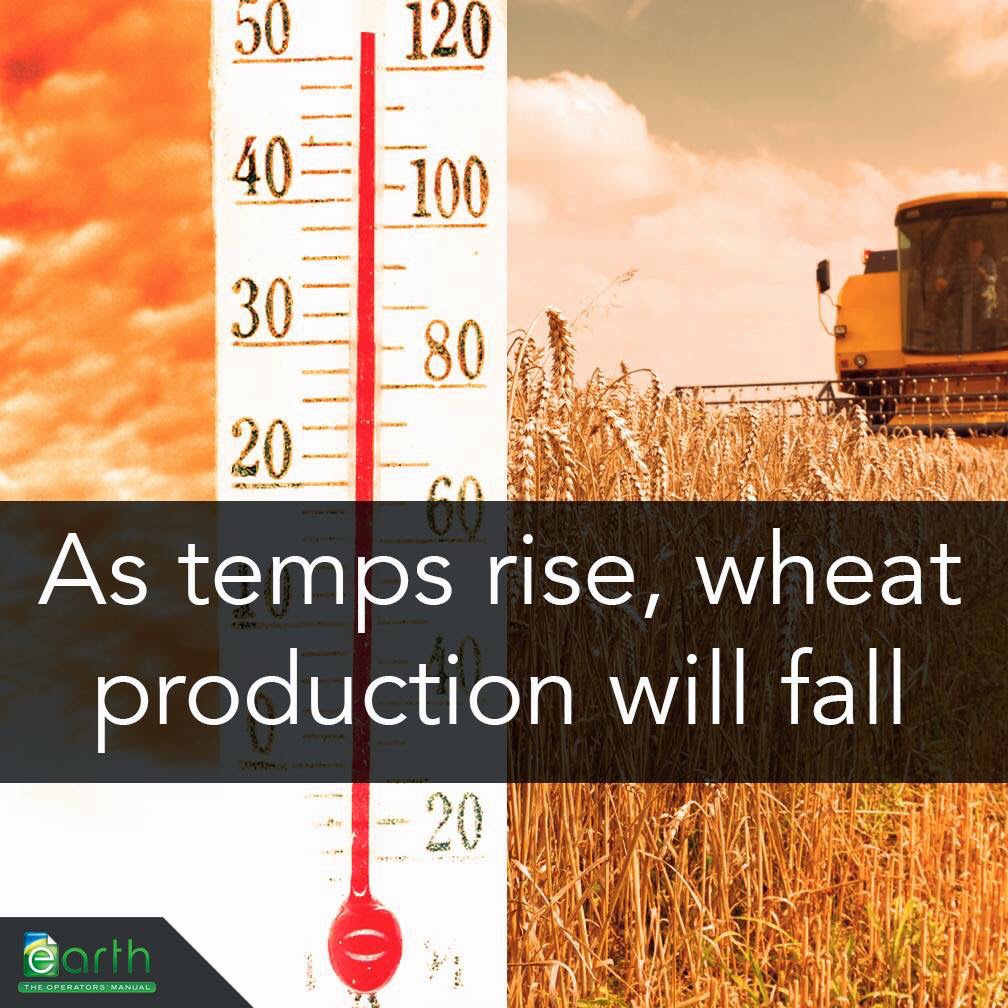
Vara Prasad, professor of crop ecophysiology and director of the USAID Feed the Future Sustainable Intensification Innovation Lab at Kansas State University, is part of a collaborative team that found wheat yields are projected to decrease by 6 percent for each degree Celsius the temperature rises if no measures to adapt to extreme weather fluctuations are taken.

Based on the 2012-2013 wheat harvest of 701 million tons worldwide, the resulting temperature increase would result in 42 million tons less produced wheat — or a loss of nearly one-quarter of the current wheat production.

“It’s pretty severe,” Prasad said. “The projected effect of climate change on wheat is more than what has been forecast. That’s challenging because the world will have to at least double our food supply in the next 30 years if we’re going to feed 9.6 billion people.”

Prasad and colleagues published their study, “Rising temperatures reduce global wheat production,” in a recent issue of the scientific journal Nature Climate Change. The study was supported through the Kansas Wheat Commission and the Kansas Wheat Alliance, two organizations seeking ways to increase wheat yield.

For the study, researchers systematically tested 30 wheat crop models against field experiments from around the world that were conducted in areas where the average temperature of the growing season ranged from 15 to 32 degrees Celsius. The models accounted for planting dates, planting rates, temperatures and other crop management factors.

With the models, researchers were able to look at the effects of temperature stresses on wheat and predict future changes based on temperature changes.

Researchers found that the effects from climate change and its increasing temperatures on wheat will be more severe than once projected and are happening sooner than expected. While Prasad said increases in the average temperature are problematic, a bigger challenge is the extreme temperatures that are resulting from climate change.

“Extreme temperature doesn’t only mean heat; it also means cold,” Prasad said. “Simply looking at the average temperature doesn’t really show us anything because it’s the extremities that are more detrimental to crops. Plants can handle gradual changes because they have time to adapt, but an extreme heat wave or cold snap can kill a plant because that adjustment period is often nonexistent.”

Researchers also found that increasing temperatures are shortening the time frame that wheat plants have to mature and produce full heads for harvest, resulting in less grain produced from each plant.

“It’s like having one minute to fill a tall glass with water. Under optimal conditions, we can fill that glass pretty well,” Prasad said. “But now we’re factoring in extreme temperatures that are affecting the growing window and the grain size. So it becomes like trying to fill that same glass, but now we only have 40 seconds to do it and the faucet is running slower.”

Currently, Prasad and colleagues at Kansas State University, in collaboration with the university’s Wheat Genetics Resource Center, are using growth chambers and heats tents to quantify the effects of temperature. The data will help in refining the crop models so that they can be more accurate in predicting wheat responses.

Their work will help scientists develop more robust models that can help farmers globally select more weather-tolerant and resilient wheat varieties based on their location. Additionally, farmers can determine the optimal planting date to avoid stress and minimize possible exposure to extreme weather events, such as heat and cold snaps, during the growing season. More


Tuesday, January 13, 2015

Global warming reduces wheat production markedly if no adaptation takes place

Future global wheat harvest is likely to be reduced by six per cent per each degree Celsius of local temperature increase if no adaptation takes place. Worldwide this would correspond to 42 million tons of yield reduction, which equals a quarter of current global wheat trade, experts warn.

Future global wheat harvest is likely to be reduced by six per cent per each degree Celsius of local temperature increase if no adaptation takes place. Worldwide this would correspond to 42 million tons of yield reduction, which equals a quarter of current global wheat trade.

Wheat plays an important role in feeding the world, but climate change threatens its future harvest. Without adaptation, global aggregate wheat production is projected to decline on average by six per cent for each additional degree Celsius temperature increase. Worldwide this would correspond to 42 million tons yield reduction for one 1°C global warming.

This result has been generated by an international research consortium to which Natural Resources Institute Finland (previously known as MTT Agrifood Research Finland) substantially contributed. The results were published online in the high impact journal Nature Climate Change.

Losses expected throughout the world

The researchers found out that in response to global temperature increases, grain yield declines are predicted for most regions in the world. Considering present global production of 701 million tons of wheat in 2012, this means a possible reduction of 42 million tons per one degree Celsius of temperature increase.

“To put this in perspective, the amount is equal to a quarter of global wheat trade, which reached 147 million tons in 2013. In addition, wheat yield declines due to climate change are likely to be larger than previously thought and should be expected earlier, starting even with small increases in temperature,” points out Prof. Dr. Reimund Rötter from Natural Resources Institute Finland.

“Therefore it is essential to understand how different climate factors interact and impact food production when reaching decisions on how to adapt to the effects of climate change.”

Increased variability weakens stability in grain supply

In the study, the researchers systematically tested 30 different wheat crop models against field experiments in which growing season mean temperatures ranged from 15 °C to 26 °C. The temperature impact on yield decline varied widely across field test conditions. In addition, year-to-year variability increased at some locations because of greater yield reductions in warmer years and lesser reductions in cooler years.

“Increased yield variability is critical economically as it could weaken regional and global stability in wheat grain supply and food security, amplifying market and price fluctuations, as experienced during recent years,” says Professor Rötter.

In its recent Assessement Report (AR5), the Intergovernmental Panel on Climate Change (IPCC) projects that global mean temperature may rise up to 5 °Celsius by the end of this century.

“Timely and adequate adaptation, such as cultivating more heat-tolerant wheat cultivars could substantially reduce climate change induced risks,” Rötter continues.

Unique and multi-locational study

Agrosystems modellers, Dr. Fulu Tao, Dr. Taru Palosuo and Prof. Dr. Reimund Rötter from Natural Resources Institute Finland participated to this collaborative research under the umbrella of AgMIP, The Agricultural Model Intercomparison and Improvement Project coordinated by Columbia University, NASA and University of Florida, USA. Apart from Finland, scientists from Germany, France, Denmark, Netherlands, Spain, UK, Columbia, Mexico, India, China, Australia, Canada and USA participated in this global study.

In a unique study set-up, the scientists first compared simulation results from a large ensemble of wheat crop growth models with experimental data, including artificial heating experiments and multi-locational field trials. They found that discrepancies between observation and simulation varied among individual models, whereby deviations increased with increasing growing season temperature.

Most reliable estimates of observed yields over the range of temperature regimes were achieved by using the multi-model ensemble median estimate. Based on these test results, scientists subsequently applied the multi-model ensemble to estimate wheat yields under increasing temperature in the main cultivation areas of the world. More


Monday, December 29, 2014

Rising Temperature / Falling Grain Production

This one's for the "plants will grow better with more C02" crowd: A new study finds that wheat production will likely fall by 6% for every 1 °C increase in global temperatures. Wheat is one of the most important food crops in the world, and we'd be smart to keep it happy.

http://bit.ly/1JXcuj1


Tuesday, August 19, 2014

Grain Harvest Fact Sheet

With grain providing much of the calories that sustain humanity, the status of the world grain harvest is a good indicator of the adequacy of the food supply.

Lester Brown

More than 2 billion tons of grain are produced each year worldwide, nearly half of it in just three countries: China, the United States, and India.

Corn, wheat, and rice account for most of the world’s grain harvest. Whereas rice and most wheat are consumed directly as food, corn is largely used for livestock and poultry feed, and for industrial purposes.

Global grain consumption has exceeded production in 8 of the last 14 years, leading to a drawdown in reserves.

Population growth is the oldest source of increasing grain demand. In recent years, the annual growth in grain use has doubled, largely a result of increased use for fuel ethanol and livestock and poultry feed.

In 2013, the United States harvested more than 400 million tons of grain. Of this, 129 million tons (30 percent) went to ethanol distilleries.

Rising yields are the key to expanding the grain harvest as there is little unused cropland. Since 1950, over 93 percent of world grain harvest growth has come from raising yields.

The global grain area planted per person has shrunk from about half an acre (0.2 hectares) in 1950 to a quarter acre (0.1 hectares) in 2013.

At 10 tons per hectare, U.S. corn yields are the highest of any major grain anywhere. In Iowa, some counties harvest up to 13 tons per hectare.

Global average grain yields more than tripled from 1.1 tons per hectare in 1950 to 3.5 tons per hectare in 2013. However, yield growth has slowed from 2.2 percent a year between 1950 and 1990 to 1.4 percent in the years since.

In France, Germany, and the United Kingdom, wheat yields have been flat for more than a decade. The story is similar for rice in Japan and South Korea.

World fertilizer use climbed from 14 million tons in 1950 to 181 million tons in 2013. But in many countries, fertilizer use has reached diminishing returns.

Since 2007, the world has experienced three major grain price spikes. The U.N. Food Price Index indicates that grain in 2014 was twice as expensive as in 2002–04.

Rising global temperatures threaten the world’s major food crops; the “rule of thumb” is that each 1-degree-Celsius rise in temperature (1.8 degrees Fahrenheit) above the growing season optimum can cut productivity by at least 10 percent. More


Monday, April 21, 2014

Wheat rust: The fungal disease that threatens to destroy the world crop

Scientists are warning that wheat is facing a serious threat from a fungal disease that could wipe out the world’s crop if not quickly contained.

Wheat rust, a devastating disease known as the “polio of agriculture”, has spread from Africa to South and Central Asia, the Middle East and Europe, with calamitous losses for the world’s second most important grain crop, after rice. There is mounting concern at the dangers posed to global food security.

Experts have been aware of the threat since a major epidemic swept across North America’s wheat belt in the 1950s, destroying up to 40 per cent of the crop. Since then, tens of millions of pounds have been invested in developing rust-resistant varieties of the grain. However, an outbreak in Uganda in 1999 was discovered to have been caused by a virulent mutation of the fungus. There has been alarm at the speed at which further mutations have subsequently developed and spread across continents.

Plant scientists in Britain estimate the latest developments mean that 90 per cent of all current African wheat varieties are now vulnerable to the disease.

Last year, Germany witnessed its first outbreak of stem rust in more than 50 years. The outbreak was spurred by “a period of unusually high temperatures and an unusually late development of the wheat crop due to cold spring and early summer temperatures”, explained Kerstin Flath, of Germany’s Federal Research Centre for Cultivated Plants.

A further outbreak occurred in Ethiopia last November, with farmers losing on average 50 per cent of their wheat crop; the worst affected lost up to 70 per cent. Experts met in Mexico last month to discuss the threat. Work is under way to examine the different strains, to identify similarities.

According to Dr David Hodson, of the International Maize and Wheat Improvement Center in Addis Ababa, the disease’s threat lies in its ability to cause “large- scale destruction in a very short period of time over very large cultivated areas”. Rust epidemics could be compared to a forest fire, Dr Hodson said. Once it manages to gain ground it can very quickly spread out of control. The fungus reproduces millions of wind-borne spores, each of which is capable of starting a new infection.

Fazil Dusunceli, of the UN’s Food and Agriculture Organisation, said that the fungal disease, along with drought, are major challenges to wheat production globally.

He warned that countries need to react quickly to counter the new fungal varieties: “Production of new seed varieties is critical.” He said the UN was looking to countries such as the US, Britain and other European nations to lead the fight. “Developed countries have well-established institutions, programmes and capacities that developing countries lack. The developing countries are not sufficiently prepared to fight against these diseases and so when epidemics occur they encounter significant losses,” he said.

British scientists from the Sainsbury Laboratory, together with those from the world-renowned John Innes centre, both in Norwich are in the vanguard of efforts to combat the outbreaks. The UK teams are trying to control the disease with genetics rather than develop more powerful chemical fungicides. The work currently includes cloning new sources of resistance from wild grasses and from barley, which they think is essentially completely resistant to wheat rust.

Academics at Cambridge University, led by Professor Christopher Gilligan, are using sophisticated mathematical models to help predict the likely spread from outbreaks. “The project is designed to develop and test mathematical models that can be used to improve understanding of when, where and how disease spreads, which regions are most at risk and how to control epidemics,” Professor Gilligan said.

Using models from the UK Meterological Office, the Cambridge team were able to predict the likely spread of the Ethiopian outbreak. “The results helped to direct sampling teams to find further outbreaks, from which it became apparent the epidemic was more severe and widespread than had been previously reported.” Further work by the modellers has identified which of the countries surrounding Ethiopia in Africa, and the Middle East, are most at risk. “The current evidence suggests that the risk of direct spread to the Indian subcontinent is small during the winter months,” Professor Gilligan said.

“The models show, however, that the fungus could spread in stages, by first infecting wheat crops in the Middle East and then spreading to other major wheat-growing areas.”

According to scientists, climate change is in part behind the threat. The aggressive spread of two forms of the fungus is widely believed to be linked to its rapid adaptation to warmer conditions. Dr Hodson said this is resulting in outbreaks in countries not previously affected, with epidemics in several countries from North Africa to South Asia. More


Wednesday, February 12, 2014

U.S.-India: Dealing With Monsoon Failure by Lester R. Brown

Earth Policy Book Byte Release - February 12, 2014

The following is an excerpt from Lester Brown’s new autobiography, Breaking New Ground: A Personal History. The first in his family to graduate from elementary school, he reveals what inspired him—and millions of those who have read his books—to become environmentally active. For more, check out Chapter 1, now up on our website, and browse through photo albums and hear from Lester Brown himself in select videos.

The scene plays out in India in 1965.

At a reception, I met the head of Indian operations for Esso (now ExxonMobil). When I asked him how business was, he said it was great. In particular, diesel sales to fuel irrigation pumps were nearly double the previous year’s level. Why? Because farmers were pumping continuously to try to save their crops.

Soon after, I met an embassy staff person, an avid duck hunter. He usually took off a few weeks in the fall to go hunting on a lake up north. This year he had canceled his vacation because the lake was dry.

An agronomist who worked with the U.S. Agency for International Development (USAID) traveled extensively in rural India and often stopped his car in the countryside to take soil samples. But he complained to me that he could no longer get good core samples: the soil was so dry it crumbled and fell out of his auger as he withdrew it.

This was something that I had never seen in my years of farming. I became convinced that India faced a huge crop shortfall.

It was the fall of 1965 and I had come to India because the USAID mission in New Delhi had asked the U.S. Department of Agriculture (USDA) for someone to help them with an agricultural analysis.

What caught my attention in New Delhi right away was the condition of that year’s grain crop. The Indian government officially estimated grain demand for 1965 would be 95 million tons. I soon began to wonder whether a harvest anywhere near this amount would materialize. I found reports of drought in virtually every corner of the country. The drought appeared to be almost everywhere.

Since the United States was the dominant world grain supplier—the only country that could even think about filling a deficit of this scale—this warranted an urgent cable to alert my boss, the U.S. Secretary of Agriculture Orville Freeman. If a potential deficit of this magnitude was a real prospect, he needed the information as soon as possible.

However, if I were going to sound such an alarm, I needed to estimate the size of the deficit, despite having only fragmentary data. If my estimate of the deficit was too high, the United States would over mobilize and waste resources. But if my estimate was too low, that could lead to famine. I worked to strike the right tone in the cable to Freeman.

Off to Rome

The cable actually went to Washington on Wednesday, November 10. On Friday of the following week, I received a cable from Secretary Freeman. It was short and cryptic: “Please meet me in Rome tomorrow morning.” He would be in Rome attending the biennial conference of agricultural ministers organized by the U.N. Food and Agriculture Organization.

At that point, I asked to meet with India’s minister of food and agriculture, C. Subramaniam, to share my assessment with him. I urged him not to play it down when he got to Rome—unless he was convinced that it was off base. Otherwise, the U.S. government would not mobilize its grain aid quickly enough and the needed shipments might not arrive in time.

When I met Secretary Freeman on Saturday morning, he said he had shared my cable with President Lyndon Johnson (LBJ). My analysis played to one of LBJ’s deepest concerns: that India was neglecting its agriculture as it concentrated on industrialization. Its government simply seemed to assume that the United States would fill any grain deficits that India might face.

Creating dependency

If India continued on this path, it would become dangerously dependent on the United States in the event of any crop shortfalls. That was all the more problematic as this was a time when scores of other countries also depended on U.S. grain.

President Johnson and his team knew that if the recent agricultural trends in India continued, eventually India’s grain needs would exceed the United States’ capacity to meet them. When an Indian official was asked by a reporter about the adequacy of the country’s grain stocks, he responded, “Our reserves are in the grain elevators in Kansas.”

It was this casual thinking about food security in India, then a country with a population more than double that of the United States and growing by 10 million per year that alarmed the U.S. president. It led to what came to be known as the “short-tether policy” on U.S. food aid.

Constructive conditionality

LBJ had asked Secretary Freeman to get a commitment from the Indians to develop their agriculture—and fast. Any continuing food aid from the United States would be contingent on this.

India was facing a potentially massive famine. I wanted to make sure that both governments understood the gravity and urgency of the situation. Rarely have two governments been in a situation where the stakes, measured in human lives, were so high.

Freeman, Subramaniam and I met on Monday morning to discuss the situation. They asked me to draft an agreement between the two countries based on our discussion. At the end of the day, I had a draft. The agreement was short, three pages double-spaced.

I knew what India had to do. The government’s food price policy, which catered to the urban population by imposing ceiling prices on wheat and rice, had to be replaced. What was needed was a floor price guarantee for the farmers growing these grains. Fertilizer supplies had to increase rapidly. This meant shifting fertilizer production from the public sector to the private sector.

There were high-yielding dwarf varieties of wheat. Initially developed in Mexico by Norman Borlaug and his colleagues with support of the Rockefeller Foundation, they had been tested in India and performed very well. India needed to accelerate the dissemination of these high-yielding wheats.

Creating linkages across borders

Once we had negotiated the agreement that contained these essential points, Freeman cabled a draft to LBJ for approval. The president approved it immediately and Secretary Freeman signed the agreement. In essence, he committed the United States to providing massive food assistance—as long as India adopted the reforms.

The Indian government’s original five-year agricultural plan was a much longer, detailed bureaucratic document. My new draft was only a few pages on the key initiatives needed. Its strength was that it linked the movement of wheat from the United States to the implementation of a new food production strategy in India. The monsoon failure and the massive looming grain deficit had changed everything.

Inside the Indian government, Agriculture Minister Subramaniam took all the necessary steps. In effect, he said: Our agriculture is in trouble. We could be facing a huge grain deficit, a potentially massive loss of life. We have to reform our agriculture. Here is what we need to do.

You reform, we deliver

One thing the Indians did not anticipate was the extent to which the Johnson Administration was going to use food aid to force the Indian government to follow through on every measure in the agreement. If the Indian government did not accomplish certain measures, the ships would stop leaving U.S. ports.

It took the Indians a while to realize that LBJ was dead serious about the reforms. Several times in the months ahead, the ships stopped sailing because India had not fulfilled its part in implementing the bilateral agreement. They would move again only when India had met its commitments.

The greatest challenge was actually importing the 10 million tons of grain in a single year when India previously had never imported anywhere near this amount before.

To assess whether—and how—this massive amount could be moved in time, Secretary Freeman called on logistics specialists in the USDA, men who had served in the Army Quartermaster Corps in World War II. During the war, they had become masters of moving equipment and arms from point A to point B. Their ingenuity was boundless.

Yankee ingenuity to help India

What they did to greatly increase India’s port capacity was to lease one of the largest supertankers afloat at the time, the Manhattan. They then anchored the massive ship in the Bay of Bengal and used it as a port.

On one side, ships from the United States arrived with grain that was pumped on board and then unloaded on the other side into small, flat-bottomed, local boats called dhows, which were about 30 feet long.

Thousands of dhows were used to move the grain up the Ganges River and its tributaries to reach the parts of the country where the drought was most severe and the risk of starvation the greatest. It was remarkably successful.

The result

Final data on the 1965 Indian harvest showed it coming in at 77 million tons of grain—18 million tons below the Indian government’s original estimated consumption. In the effort to stave off famine, the United States that year shipped a fifth of its wheat harvest to India.

At that time, it was the largest movement of food ever between two countries. Some 600 ships, nearly two a day, left U.S. ports laden with wheat for India. Measured by the number of ships used in a single logistical operation, it ranks high on the all-time list. This record flow of food from the United States to India avoided what could have been one of history’s most devastating famines.

With the new agricultural development strategy, India doubled its wheat harvest in seven years, a record for growth in production of a food staple in a major country. No country, not even the United States, had ever managed such rapid growth.

For the United States, this was one of our finest moments. And not just because millions of lives were saved, but because our government had seen a rare opportunity to restructure India’s agriculture by dramatically boosting land productivity. More

Could a similar scene play out again on the sub-continent due to a spike in oil prices or changes in monsoon? Editor

# # #

This essay is an adapted excerpt from Breaking New Ground: A Personal History, by Lester R. Brown, New York, W.W. Norton, 2013, and originally appeared in The Globalist on February 6, 2014. Photo albums, videos, and additional resources are available for free download at www.earth-policy.org/books/bng.

Feel free to pass this information along to friends, family members, and colleagues!

Media Contact: Reah Janise Kauffman (202) 496-9290 ext. 12 | rjk@earthpolicy.org

Research Contact: Janet Larsen (202) 496-9290 ext. 14 | jlarsen@earthpolicy.org


Wednesday, May 29, 2013

Unapproved Monsanto crop found growing in Oregon

A genetically modified strain of wheat that was never approved by the United States Department of Agriculture as been discovered growing in Oregon, triggering a federal probe that is now spanning several states.

Investigators with the USDA want to know why the GMO crop, made by biotech company Monsanto but never approved for use, sprouted up in a field in the Pacific Northwest.

America’s wheat trade could be jeopardized if concerns grow among foreign consumers already weary of genetically engineered and modified organisms. Several countries across the European Union have banned the

cultivation of GMO crops, and last weekend anti-Monsanto demonstrations were attended by millions of protesters on six continents.

The USDA has yet to approve any GMO strain of wheat to be grown in the US, but Monsanto field tested a genetically engineered variety from 1998 through 2005 before withdrawing their application from the agency’s regulatory approval process.

The wheat, resistant to Monsanto’s patented pesticide Roundup, is one of many GMO crops in the company’s line of “Roundup Ready” products. After a farmer in Oregon noticed that wheat plants on his property were still growing despite dousing his field with the pesticide, he alerted Michael Firko, the deputy administrator of the USDA’s Animal and Plant Health Inspection Service, Bloomberg News reported Wednesday.

We are taking this very seriously,” Firko said. “We have a very active investigation going on in several states in the western US.”

According to a 2003 article in the Billings, Montana Gazette, Monsanto pledged that its GMO wheat crop resistant to strong pesticides would not be introduced commercially until proven complete safe and approved in the US, Canada and Japan.

"We have to prove the safety of the gene, the food, the animal feed and the environment. That it is as safe as unmodified varieties and (nutritionally) is substantially equivalent to commercial varieties,” Monsanto’s then director of industry affairs, Michael Doane, told the Gazette at the time.

So far, the USDA has determined that the wheat crop in question was the same variety tested by Monsanto up until eight years ago. The US Food and Drug Administration found no safety concerns with the crop after completing a test in 2004, but Monsanto suspended plans to follow through with the product the following year without receiving the USDA’s stamp of approval.

Despite growing criticism from agriculturalists, environmentalists and consumers over potential health risks, Monsanto continues to attest that GMOs could change the world’s food landscape for the better.

There is space in the supermarket shelf for all of us,” Monsanto CEO Hugh Grant told a reporter for Bloomberg earlier this month. More

________________________________

Let me get this straight, the USDA will not allow this GMO wheat to be sold in the USA, BUT will not mandate the labeling of GMO products? Do you trust your government? Editor

Wednesday, December 26, 2012

Study: Global crop production shows some signs of stagnating

After decades of rapidly growing global agricultural output, production of four of the world’s most important crops could be stagnating or even slowing in some regions, according to a new study published in Nature, a top scientific journal.

The study, by the University of Minnesota’s Deepak Ray and four others, examined millions of census reports from the last half century to gather their data.

The authors are careful to point out that crop production is still increasing in parts of the world; it is by no means a categorical decline. The report’s abstract reads summarizes, “Although yields continue to increase in many areas, we find that across 24–39% of maize-, rice-, wheat- and soybean-growing areas, yields either never improve, stagnate or collapse.” That’s about a quarter to a third of global production of four of our most important crops.

This is potentially a very big deal. World populations are still growing. So is the global middle class, members of which tend to consume more meat and dairy per person, which means more crops per person. That’s been happening for a while, and it’s been fine as long as food production has kept pace. But the pace of crop production growth appears to be slowing in some really important regions, particularly in parts of India and China – and, yes, the U.S.

How did this happen? Study co-author Jonathan Foley, talking to Science Daily, suggests one possible explanation. “This finding is particularly troubling because it suggests that we have preferentially focused our crop improvement efforts on feeding animals and cars, as we have largely ignored investments in wheat and rice, crops that feed people and are the basis of food security in much of the world,” he said. Yikes. More


Monday, September 3, 2012

Hunger Games: The price of feeding the world

Have banks been speculating on food markets and could this contribute to pushing millions into hunger and poverty?

"The real problem is not that food is becoming more expensive, it's that money is losing value. Central banks all around the world are simply printing too much money and so you need more money to buy food. It's not the weather, it's not speculation, it's the inflation that central banks around the world are creating." - Peter Schiff, the CEO of Euro Pacific Capital

The NGO said Barclays had reportedly made more than $800m over the past two years from speculating on food markets and that investors were using the food market as a "playground".

It said this has contributed to hunger and poverty not only for millions in poor countries, but also in developed nations.

The allegations come on the back of a World Bank global hunger warning. According to a report by the bank released this week, global food prices have hit record highs. In July alone, its global food index increased by 10 per cent. More: Al Jazeera.

The program discusses the reasons for the increasing cost of food and what is being done to curb record highs. Teymoor Nabili discusses with Christine Haigh,Peter Schiff,& Aly Khan Satchu.


Wednesday, August 8, 2012

The hunger wars in our future: Heat, drought, rising food costs, and global unrest

The mass unrest of the Arab Spring was triggered in part by rising food prices. In Algeria (above), the government slashed food prices in response to protests.

Photo by Magharebia
The Great Drought of 2012 has yet to come to an end, but we already know that its consequences will be severe. With more than one-half of America’s counties designated as drought disaster areas, the 2012 harvest of corn, soybeans, and other food staples is guaranteed to fall far short of predictions. This, in turn, will boost food prices domestically and abroad, causing increased misery for farmers and low-income Americans and far greater hardship for poor people in countries that rely on imported U.S. grains.

This, however, is just the beginning of the likely consequences: If history is any guide, rising food prices of this sort will also lead to widespread social unrest and violent conflict.

Food — affordable food — is essential to human survival and well-being. Take that away, and people become anxious, desperate, and angry. In the United States, food represents only about 13 percent of the average household budget, a relatively small share, so a boost in food prices in 2013 will probably not prove overly taxing for most middle- and upper-income families. It could, however, produce considerable hardship for poor and unemployed Americans with limited resources. “You are talking about a real bite out of family budgets,” commented Ernie Gross, an agricultural economist at Omaha’s Creighton University. This could add to the discontent already evident in depressed and high-unemployment areas, perhaps prompting an intensified backlash against incumbent politicians and other forms of dissent and unrest.

It is in the international arena, however, that the Great Drought is likely to have its most devastating effects. Because so many nations depend on grain imports from the U.S. to supplement their own harvests, and because intense drought and floods are damaging crops elsewhere as well, food supplies are expected to shrink and prices to rise across the planet. “What happens to the U.S. supply has immense impact around the world,” says Robert Thompson, a food expert at the Chicago Council on Global Affairs. As the crops most affected by the drought, corn and soybeans, disappear from world markets, he noted, the price of all grains, including wheat, is likely to soar, causing immense hardship to those who already have trouble affording enough food to feed their families.

The Hunger Games, 2007-2011

What happens next is, of course, impossible to predict, but if the recent past is any guide, it could turn ugly. In 2007 to 2008, when rice, corn, and wheat experienced prices hikes of 100 percent or more, sharply higher prices — especially for bread — sparked “food riots” in more than two dozen countries, including Bangladesh, Cameroon, Egypt, Haiti, Indonesia, Senegal, and Yemen. In Haiti, the rioting became so violent and public confidence in the government’s ability to address the problem dropped so precipitously that the Haitian Senate voted to oust the country’s prime minister, Jacques-Édouard Alexis. In other countries, angry protestors clashed with army and police forces, leaving scores dead.

Those price increases of 2007 to 2008 were largely attributed to the soaring cost of oil, which made food production more expensive. (Oil’s use is widespread in farming operations, irrigation, food delivery, and pesticide manufacture.) At the same time, increasing amounts of cropland worldwide were being diverted from food crops to the cultivation of plants used in making biofuels.

The next price spike, in 2010 to 2011, was, however, closely associated with climate change. An intense drought gripped much of eastern Russia during the summer of 2010, reducing the wheat harvest in that breadbasket region by one-fifth and prompting Moscow to ban all wheat exports. Drought also hurt China’s grain harvest, while intense flooding destroyed much of Australia’s wheat crop. Together with other extreme-weather-related effects, these disasters sent wheat prices soaring by more than 50 percent and the price of most food staples by 32 percent. More

How will this affect China and South Asia? With the drought in China and Russia and flooding in South Asia in recent years, how will rising prices and potential shortages affect these countries? Editor.