Showing posts with label rains. Show all posts

Thursday, January 1, 2015

Behind the veil of the Islamic State is a war for water

A little known fact of the war in Syria is that it started at the end of the worst drought in Syrian history, a biblical drought which forced over 1 million farmers into the cities.

Pulitzer Prize-winner Thomas L. Friedman interviewed Syrian refugees and farmers in Syria about the link between this drought and the start of the civil war. He comes to the conclusion that the drought certainly played some role and was probably a key tipping point for a bad situation to turn into a full scale war. In the documentary “Years of living dangerously” we see how wiki-leaked diplomatic cables and high level US officials such as Condoleezza Rice acknowledge this link.
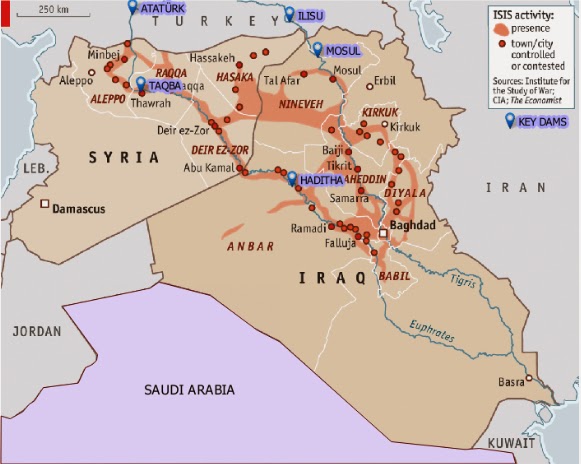
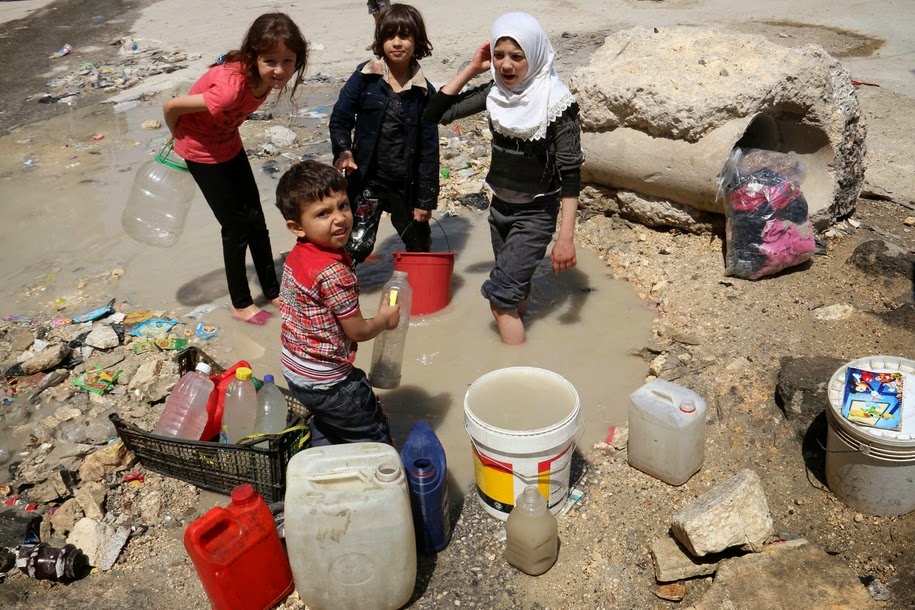
But there’s a lot more happening to explain why behind the veil of a quest for an Islamic State (IS), there’s also a war for water in Syria and Iraq. Making the plight of citizens worse is the continued targeting of water supply networks by both regime and opposition forces, which have attacked strategic lifelines, such as water channels, to gain control of territory and to punish and put pressure on their opponents.

Opening the flood gates …

The Islamic State’s quest for hydrological control began in Syria, when it captured the Tabqa Dam in 2013. Rebel-held areas had been systematically denied electricity by President Bashar al-Assad’s forces in their effort to turn the population against the insurgency. The Tabqa Dam was built more than 40 years ago with Russian help and aimed to make Syria self-sufficient in energy production. Behind the dam is Lake Assad, which provides millions of Syrians with drinking water and is a vital irrigation source for farms. After the capture of the dam, IS opened the flood-gates to get maximum electricity supply for the areas they control and win favour with the local population. As a result, the lake dropped six metres, to a record low in May, which worsened the plight of millions of already destitute Syrians as severe water cuts began to hit Aleppo province.
Conflict over the water flowing though the Euphrates and Tigris is of course nothing new and predates religious wars. They were the first rivers to be used for large scale irrigation, in the region once known as the Fertile Crescent. Somewhere between 1720 and 1684 BC, a grandson of Hammurabi dammed the Tigris to prevent the retreat of rebels led by Iluma-Ilum, who declared the independence of Babylon. The Euphrates was already used as a weapon somewhere around 2500 BC, in another fight for Babylon, when the king of Umma cut the banks of irrigation canals alongside the Euphrates dug by his neighbor, the king of Girsu.

The Euphrates and Tigris are the two major and longest rivers in the Middle East. They both originate in Turkey. The Euphrates flows through Syria and Iraq to reach the Persian Gulf while the Tigris flows through Kurdish territory, meeting up with the Euphrates in the Southern Mesopotamian Marshes of Iraq. There are currently at least 46 dams in the Tigris-Euphrates basin, with at least 8 more planned or under construction. These dams have become key pieces of geo-political control in the region.

… and shutting down the flows

While one act of war is opening the flood gates, another is closing them. In 1974, Iraq threatened to bomb the same Tabqa Dam in Syria, alleging that the dam had reduced the flow of Euphrates River water to Iraq. But between then and now, Turkey, through its position upstream, has taken over as the most powerful regional commander of water, by completing the giant Ataturk Dam. In 1990 Syria and Iraq protested that Turkey now has a weapon of war: by closing the gates they could leave them dry. They had good reason to protest. In mid-1990 Turkish president Turgut Özal threatened to restrict water flow to Syria to force it to withdraw support for Kurdish rebels operating in southern Turkey.

In April 2014, the Islamic State blamed the low water levels in Lake Assad to Turkey’s closure of the Ataturk Dam. Sources found by Al Jazeera said that these claims are disputed. But even if the allegations are only partly true: they were used by the Islamic State to issue threats to ‘liberate Istanbul’, if that was necessary. So while Turkey, IS and Assad fight over water, millions of ordinary Syrians and Iraqi’s see their water levels drop dramatically. Not just by a new drought, with rainfall down by 50-85 percent since October 2013, but mostly due to a power struggle.

Tensions over water control in the region are set to heat up further if Turkey completes the Ilisu Dam on the Tigris River near the border of Syria. The Ilisu Dam will generate 1,200 MW and is part of the vast and ambitious Southeastern Anatolia Project, known as GAP after its Turkish title (Guneydogu Anadolu Projesi): a network comprising 22 dams and 19 power plants. The Ilisu reservoir will flood 52 villages and 15 towns, including Hasankeyf, a Kurdish town of 5,500 people, which is the only town in Anatolia that has survived since the Middle Ages and is under archaeological protection. It will displace approximately 16,000 people in the troubled Kurdish region.

The World Bank (WB), the British construction company Balfour Beatty and the Italian company Impreglio have all withdrawn from the problematic project. So have international funds and export credit from Austria, Germany and Switzerland. However, the project is currently funded by Turkish banks. Iraq and also Syria will be the most heavily impacted if the dam and others go through, with the most extreme projections holding that, owing to a combination of climate change and upstream dam activity, the Tigris and Euphrates rivers won’t have sufficient flow to reach the sea by as early as 2040.

If you live in Syria or Iraq and the water irrigating your field stops coming you might join the ranks of any army promising to attack those who kept the water for themselves – no matter if they tell you the truth or not. As is often the case in conflicts or epidemics it is not the facts themselves that count most but what people believe to be the facts. Those who can convince it’s the enemies fault that there’s not enough water will have the key to where the hearts and minds of the people will go to – no matter what the facts are.

The US finally finds a Weapon of Mass Destruction in Iraq

The Tabqa Dam is not the only dam attacked by IS. They are also trying to take the Haditha Dam, the second-largest in Iraq, raising the possibility of catastrophic damage and flooding. On Sunday, the US was bombing IS positions close to the dam. The IS militants are also fighting for control of the Euphrates River Dam, about 120 miles northwest of Baghdad and government forces were fighting to halt their advance. Insurgents from IS seized the Falluja Dam in Iraq in February and closed the floodgates to cause upstream flooding and to cut downstream water supply. Some 40.000 people were displaced just to flood the area around the city of Falluja to force government troops to retreat and lift a siege, while cutting water supplies and hydroelectricity generation for other parts of the country. All that was peanuts compared to what IS did next.

On August 7 IS captured the 1GW Mosul Dam on the Tigris – sending shock waves through Bagdad, Kuwait and the US. Whoever controls the Mosul Dam, the largest in Iraq, controls most of the country’s water and power resources. Located on the Tigris River upstream of Mosul, the dam, 3.6 km long and with 320 MW of capacity daily, formerly known as the Saddam dam, was built beginning in 1980 at a cost of 1.5$ billion USD, to bolster the regime during the Iran-Iraq war by a German-Italian consortium that was led by Hochtief Aktiengesellschaft. Its construction submerged many archaeological sites in the region yet more troubling is that because the dam was constructed on a foundation of soluble gypsum, it requires continuous grouting of the dam’s foundation to promote stability. Due to the engineering problems it presents it has been described recently by US engineers as “the most dangerous dam in the world.” And that was before the “most dangerous terror group ever” captured it.

A senior U.S. administration official said that “The failure of the Mosul Dam could threaten the lives of large numbers of civilians, threaten U.S. personnel and facilities – including the U.S. Embassy in Baghdad – and prevent the Iraqi government from providing critical services to the Iraqi populace,” (Source: Reuters). A 2006 U.S. Army Corps of Engineers report obtained by the Washington Post said the dam, which blocks the Tigris and holds 12 billion cubic meters of water, could flood two cities killing over a half a million people if it were destroyed or collapsed. The tsunami going to Mosul, a city of 1.7 million people, can be 20m high if the dam breaks with a full reservoir.

But even without a catastrophic failure, the dam is already at the epicenter of the war. Soon after the Islamic State captured the Mosul Dam they cut supplies to some villages in the north of the country that have not joined their cause. Recapturing this instrument of war was a sufficient reason for US forced to deploy air power to support Kurdish forces to recapture the dam. Saving the Yazidis from their mountain captured most media attention, but a key reason for the US to bomb Iraqi soil for the first time since 2011 was the fact that IS took the Mosul Dam. After bombing IS positions for several days, freshly re-equipped Kurdish fighters recently regained control of the dam.

Mega Dams & Water Management Practices

The importance of hydro-infrastructure in these battles and how it can be wielded firstly underlines the need for a serious re-appraisal of water management practices. Big dams (with funding from Multilateral agencies such as the WB, national and regional development banks, private equity and pension funds as well as from the Clean Development Mechanism, etc.) cause large scale displacement of populations, are ecologically destructive, wash away any other source of livelihood, and often saddle countries with debt while performing well below planned outputs as regards electricity generation. Moreover, compounded by climate change, contemporary ecological crises are leading to ever more conflict over trans-boundary water rights, such as for example between Ethiopia and Egypt, which are also on the verge of war over the construction of the Grand Renaissance and Gibe 3 dams, which would become Africa’s tallest. The world’s Big Dam Fan Club should take note of what has just happened in Syria and Iraq and realise that once disaster hits, hatred will not go to any God but to those who constructed the weapon of mass destruction. Water, rather than oil, is shaping up to be the key strategic resource in the region. More


Thursday, November 20, 2014

Wells Dry, Fertile Plains Turn to Dust

HASKELL COUNTY, Kan. — Forty-nine years ago, Ashley Yost’s grandfather sank a well deep into a half-mile square of rich Kansas farmland. He struck an artery of water so prodigious that he could pump 1,600 gallons to the surface every minute.

Last year, Mr. Yost was coaxing just 300 gallons from the earth, and pumping up sand in order to do it. By harvest time, the grit had robbed him of $20,000 worth of pumps and any hope of returning to the bumper harvests of years past.

“That’s prime land,” he said not long ago, gesturing from his pickup at the stubby remains of last year’s crop. “I’ve raised 294 bushels of corn an acre there before, with water and the Lord’s help.” Now, he said, “it’s over.”

The land, known as Section 35, sits atop the High Plains Aquifer, a waterlogged jumble of sand, clay and gravel that begins beneath Wyoming and South Dakota and stretches clear to the Texas Panhandle. The aquifer’s northern reaches still hold enough water in many places to last hundreds of years. But as one heads south, it is increasingly tapped out, drained by ever more intensive farming and, lately, by drought.

Vast stretches of Texas farmland lying over the aquifer no longer support irrigation. In west-central Kansas, up to a fifth of the irrigated farmland along a 100-mile swath of the aquifer has already gone dry. In many other places, there no longer is enough water to supply farmers’ peak needs during Kansas’ scorching summers.

And when the groundwater runs out, it is gone for good. Refilling the aquifer would require hundreds, if not thousands, of years of rains.

This is in many ways a slow-motion crisis — decades in the making, imminent for some, years or decades away for others, hitting one farm but leaving an adjacent one untouched. But across the rolling plains and tarmac-flat farmland near the Kansas-Colorado border, the effects of depletion are evident everywhere. Highway bridges span arid stream beds. Most of the creeks and rivers that once veined the land have dried up as 60 years of pumping have pulled groundwater levels down by scores and even hundreds of feet.

On some farms, big center-pivot irrigators — the spindly rigs that create the emerald circles of cropland familiar to anyone flying over the region — now are watering only a half-circle. On others, they sit idle altogether.

Two years of extreme drought, during which farmers relied almost completely on groundwater, have brought the seriousness of the problem home. In 2011 and 2012, the Kansas Geological Survey reports, the average water level in the state’s portion of the aquifer dropped 4.25 feet — nearly a third of the total decline since 1996.

And that is merely the average. “I know my staff went out and re-measured a couple of wells because they couldn’t believe it,” said Lane Letourneau, a manager at the State Agriculture Department’s water resources division. “There was a 30-foot decline.”

Kansas agriculture will survive the slow draining of the aquifer — even now, less than a fifth of the state’s farmland is irrigated in any given year — but the economic impact nevertheless will be outsized. In the last federal agriculture census of Kansas, in 2007, an average acre of irrigated land produced nearly twice as many bushels of corn, two-thirds more soybeans and three-fifths more wheat than did dry land.

Farmers will take a hit as well. Raising crops without irrigation is far cheaper, but yields are far lower. Drought is a constant threat: the last two dry-land harvests were all but wiped out by poor rains.

In the end, most farmers will adapt to farming without water, said Bill Golden, an agriculture economist at Kansas State University. “The revenue losses are there,” he said. “But they’re not as tremendously significant as one might think.”

Some already are. A few miles west of Mr. Yost’s farm, Nathan Kells cut back on irrigation when his wells began faltering in the last decade, and shifted his focus to raising dairy heifers — 9,000 on that farm, and thousands more elsewhere. At about 12 gallons a day for a single cow, Mr. Kells can sustain his herd with less water than it takes to grow a single circle of corn.

“The water’s going to flow to where it’s most valuable, whether it be industry or cities or feed yards,” he said. “We said, ‘What’s the higher use of the water?’ and decided that it was the heifer operation.”

The problem, others say, is that when irrigation ends, so do the jobs and added income that sustain rural communities.

“Looking at areas of Texas where the groundwater has really dropped, those towns are just a shell of what they once were,” said Jim Butler, a hydrogeologist and senior scientist at the Kansas Geological Survey.

The villain in this story is in fact the farmers’ savior: the center-pivot irrigator, a quarter- or half-mile of pipe that traces a watery circle around a point in the middle of a field. The center pivots helped start a revolution that raised farming from hardscrabble work to a profitable business.

Since the pivots’ debut some six decades ago, the amount of irrigated cropland in Kansas has grown to nearly three million acres, from a mere 250,000 in 1950. But the pivot irrigators’ thirst for water — hundreds and sometimes thousands of gallons a minute — has sent much of the aquifer on a relentless decline. And while the big pivots have become much more efficient, a University of California study earlier this year concluded that Kansas farmers were using some of their water savings to expand irrigation or grow thirstier crops, not to reduce consumption.

A shift to growing corn, a much thirstier crop than most, has only worsened matters. Driven by demand, speculation and a government mandate to produce biofuels, the price of corn has tripled since 2002, and Kansas farmers have responded by increasing the acreage of irrigated cornfields by nearly a fifth.

At an average 14 inches per acre in a growing season, a corn crop soaks up groundwater like a sponge — in 2010, the State Agriculture Department said, enough to fill a space a mile square and nearly 2,100 feet high.

Sorghum, or milo, gets by on a third less water, Kansas State University researchers say — and it, too, is in demand by biofuel makers. As Kansas’ wells peter out, more farmers are switching to growing milo on dry land or with a comparative sprinkle of irrigation water.

But as long as there is enough water, most farmers will favor corn. “The issue that often drives this is economics,” said David W. Hyndman, who heads Michigan State University’s geological sciences department. “And as long as you’ve got corn that’s $7, then a lot of choices get made on that.”

Of the 800 acres that Ashley Yost farmed last year in Haskell County, about 70 percent was planted in corn, including roughly 125 acres in Section 35. Haskell County’s feedlots — the county is home to 415,000 head of cattle — and ethanol plants in nearby Liberal and Garden City have driven up the price of corn handsomely, he said.

But this year he will grow milo in that section, and hope that by ratcheting down the speed of his pump, he will draw less sand, even if that means less water, too. The economics of irrigation, he said, almost dictate it.

“You’ve got $20,000 of underground pipe,” he said. “You’ve got a $10,000 gas line. You’ve got a $10,000 irrigation motor. You’ve got an $89,000 pivot. And you’re going to let it sit there and rot?

“If you can pump 150 gallons, that’s 150 gallons Mother Nature is not giving us. And if you can keep a milo crop alive, you’re going to do it.”

Mr. Yost’s neighbors have met the prospect of dwindling water in starkly different ways. A brother is farming on pivot half-circles. A brother-in-law moved most of his operations to Iowa. Another farmer is suing his neighbors, accusing them of poaching water from his slice of the aquifer.

A fourth grows corn with an underground irrigation system that does not match the yields of water-wasting center-pivot rigs, but is far thriftier in terms of water use and operating costs.

For his part, Mr. Yost continues to pump. But he also allowed that the day may come when sustaining what is left of the aquifer is preferable to pumping as much as possible.

Sitting in his Ford pickup next to Section 35, he unfolded a sheet of white paper that tracked the decline of his grandfather’s well: from 1,600 gallons a minute in 1964, to 1,200 in 1975, to 750 in 1976.

When the well slumped to 500 gallons in 1991, the Yosts capped it and drilled another nearby. Its output sank, too, from 1,352 gallons to 300 today.

This year, Mr. Yost spent more than $15,000 to drill four test wells in Section 35. The best of them produced 195 gallons a minute — a warning, he said, that looking further for an isolated pocket of water would be costly and probably futile.

“We’re on the last kick,” he said. “The bulk water is gone.” More


Thursday, May 29, 2014

Allan Savory: How to fight desertification and reverse climate change

"Desertification is a fancy word for land that is turning to desert," begins Allan Savory in this quietly powerful talk. And it's happening to about two-thirds of the world's grasslands, accelerating climate change and causing traditional grazing societies to descend into social chaos.Savory has devoted his life to stopping it. He now believes — and his work so far shows — that a surprising factor can protect grasslands and even reclaim degraded land that was once desert.

Allan Savory works to promote holistic management in the grasslands of the world.

Monday, May 19, 2014

The California Drought Is Far From Over, And The Entire State Is Suffering

For a few days last month, it rained in San Francisco. Residents across the city cheered a welcomed respite from a drought that has crippled California for more than two years -- but the celebration turned out to be premature.

On Thursday, for the first time this century, the U.S. Drought Monitor declared that all of California is in a “severe” drought, with many areas of the state in an even worse condition, from "extreme" to "exceptional," the poorest possible rating.

“This is a once-in-a-generation conversation,” Mark Svoboda, a climatologist at the National Drought Mitigation Center, told The Huffington Post. He added that the last time California experienced comparable conditions was in the mid-1970s.

“The state has doubled its population between then and now,” Svoboda said. “You’ve got a lot more people using a relatively finite amount of water.”

The map below, courtesy of the U.S. Drought Monitor, shows the varying levels of drought throughout California. The orange represents “severe,” the red is “extreme,” and the maroon is “exceptional” -- the agency’s highest level (Story continues below):

No area of the state is feeling the effects of the drought more harshly than San Diego, where wildfires have ripped through more than 10,000 acres of land and tens of thousands of residents have been forced to evacuate. “In a drought, the biggest threat to health and human safety is wildfire,” Doug Carlson, an information officer at the California Department of Water Resources, told HuffPost.

And there doesn’t appear to be an end in sight. “The drought has set the stage for a very busy, very long, potentially very dangerous fire season,” Daniel Berlant, a spokesperson for CAL FIRE, said to HuffPost. “As we move into the more traditional summer months, the days are only going to get longer, and the temperatures are only going to get higher.”

California’s wildfire season usually peaks during summer and fall months and then tapers during the typically rainy winter. But the drought has turned wildfires into a year-round issue. “With that lack of rain, the grass, brush and trees really have been tinder-dry all year long,” Berlant explained, noting such conditions help flames flourish.

Svoboda added that the state’s hot, dry surface leads to a hot, dry, atmosphere, which creates a prime environment for wildfires to spread. “You also typically see windier conditions,” he added. “These are all things that fires feed on.”

The damage in Southern California has ravaged hills, homes and businesses. Beloved craft brewery Stone Brewing Company evacuated its premises on Thursday. On Wednesday, KTLA senior producer Marcus Smith tweeted a widely-recirculated photo of a “firenado,” a dangerous phenomenon caused by strong winds whipping spirals of fire into the air. More


Tuesday, March 4, 2014

Increasing homogeneity of world food supplies warns of serious implications for farming and nutrition

A comprehensive new study of global food supplies confirms and thoroughly documents for the first time what experts have long suspected: over the last five decades, human diets around the world have grown ever more similar -- by a global average of 36 percent -- and the trend shows no signs of slowing, with major consequences for human nutrition and global food security.

A comprehensive new study of global food supplies confirms and thoroughly documents for the first time what experts have long suspected: over the last five decades, human diets around the world have grown ever more similar -- by a global average of 36 percent -- and the trend shows no signs of slowing, with major consequences for human nutrition and global food security.

"More people are consuming more calories, protein and fat, and they rely increasingly on a short list of major food crops, like wheat, maize and soybean, along with meat and dairy products, for most of their food," said lead author Colin Khoury, a scientist at the Colombia-based International Center for Tropical Agriculture (CIAT), which is a member of the CGIAR Consortium. "These foods are critical for combating world hunger, but relying on a global diet of such limited diversity obligates us to bolster the nutritional quality of the major crops, as consumption of other nutritious grains and vegetables declines."

The new study, published in the Proceedings of the National Academy of Sciences, suggests that growing reliance on a few food crops may also accelerate the worldwide rise in obesity, heart disease and diabetes, which are strongly affected by dietary change and have become major health problems, "even within countries still grappling with significant constraints in food availability." The study calls for urgent efforts to better inform consumers about diet-related diseases and to promote healthier, more diverse food alternatives.

The research reveals that the crops now predominant in diets around the world include several that were already quite important a half-century ago -- such as wheat, rice, maize and potato. But the emerging "standard global food supply" described by the study also consists of energy-dense foods that have risen to global fame more recently, like soybean, sunflower oil and palm oil. Wheat is a major staple in 97.4 percent of countries and rice in 90.8 percent; soybean has become significant to 74.3 percent of countries.

In contrast, many crops of considerable regional importance -- including cereals like sorghum, millets and rye, as well as root crops such as sweet potato, cassava and yam -- have lost ground. Many other locally significant grain and vegetable crops -- for which globally comparable data are not available -- have suffered the same fate. For example, a nutritious tuber crop known as Oca, once grown widely in the Andean highlands, has declined significantly in this region both in cultivation and consumption.

"Another danger of a more homogeneous global food basket is that it makes agriculture more vulnerable to major threats like drought, insect pests and diseases, which are likely to become worse in many parts of the world as a result of climate change," said Luigi Guarino, a study co-author and senior scientist at the Global Crop Diversity Trust, headquartered in Germany. "As the global population rises and the pressure increases on our global food system, so does our dependence on the global crops and production systems that feed us. The price of failure of any of these crops will become very high."

As the authors probed current trends in food consumption, they documented a curious paradox: as the human diet has become less diverse at the global level over the last 50 years, many countries, particularly in Africa and Asia, have actually widened their menu of major staple crops, while changing to more globalized diets.

"In East and Southeast Asia, several major foods -- like wheat and potato -- have gained importance alongside longstanding staples, like rice," Khoury noted. "But this expansion of major staple foods has come at the expense of the many diverse minor foods that used to figure importantly in people's diets."

The dietary changes documented in the study are driven by powerful social and economic forces. Rising incomes in developing countries, for example, have enabled more consumers to include larger quantities of animal products, oils and sugars in their diets. Moreover, urbanization in these countries has encouraged greater consumption of processed and fast foods. Related developments, including trade liberalization, improved commodity transport, multinational food industries, and food safety standardization have further reinforced these trends.

"Countries experiencing rapid dietary change are also quickly seeing rises in the associated diseases of overabundance," said Khoury. "But hopeful trends are also apparent, as in Northern Europe, where evidence suggests that consumers are tending to buy more cereals and vegetables and less meat, oil and sugar."

The researchers single out five actions that are needed to foster diversity in food production and consumption and thus improve nutrition and food security:

  • Actively promote the adoption of a wider range of varieties of the major crops worldwide to boost genetic diversity and thus reduce the vulnerability of the global food system in the face of challenges that include climate change, rising food demand, and increased water and land scarcity. This action is especially important for certain crops, like banana, for which production is dominated by a very few, widely grown commercial varieties.
  • Support the conservation and use of diverse plant genetic resources -- including farmers' traditional varieties and wild species related to crops -- which are critical for broadening the genetic diversity of the major crops. Key measures needed are more vigorous implementation of the International Treaty on Plant Genetic Resources for Food and Agriculture to better safeguard and share these genetic resources internationally, and increased investment in crop breeding and related research.
  • Enhance the nutritional quality of the major crops on which people depend -- for example, through crop breeding to improve the content of micronutrients like iron and zinc -- and make supplementary vitamins and other nutrient sources more widely available.
  • Promote alternative crops that can boost the resilience of farming and make human diets healthier through research aimed at making these crops more competitive in domestic and international markets. Key measures include identifying and conserving nutritious locally grown "neglected and underutilized" crops, fostering their production potential through crop breeding, and increasing their use through awareness raising and policy.
  • Foster public awareness of the need for healthier diets, based on better decisions about what and how much we eat as well as the forms in which we consume food.

This comprehensive new study, relying on data from the Food and Agriculture Organization of the United Nations (FAO), encompassed more than 50 crops and over 150 countries (accounting for 98 percent of the world's population) during the period 1961-2009. In addition to CIAT and the Global Crop Diversity Trust, it involved researchers from Wageningen University in The Netherlands and the University of British Columbia in Canada.

"International agencies have hammered away in recent years with the message that agriculture must produce more food for over 9 billion people by 2050," said co-author Andy Jarvis, director of policy research at CIAT and leader for climate change adaptation with the CGIAR Research Program on Climate Change, Agriculture and Food Security (CCAFS), which CIAT leads. "Just as important is the message that we need a more diverse global food system. This is the best way, not only to combat hunger, malnutrition, and over-nutrition, but also to protect global food supplies against the impacts of global climate change." More


Wednesday, January 8, 2014

Many Countries Reaching Diminishing Returns in Fertilizer Use

When German chemist Justus von Liebig demonstrated in 1847 that the major nutrients that plants removed from the soil could be applied in mineral form, he set the stage for the development of the fertilizer industry and a huge jump in world food production a century later.

Growth in food production during the nineteenth century came primarily from expanding cultivated area. It was not until the mid-twentieth century, when land limitations emerged and raising yields became essential, that fertilizer use began to rise.

The growth in the world fertilizer industry after World War II was spectacular. Between 1950 and 1988, fertilizer use climbed from 14 million to 144 million tons. This period of remarkable worldwide growth came to an end when fertilizer use in the former Soviet Union fell precipitously after heavy subsidies were removed in 1988 and fertilizer prices there moved to world market levels. After 1990, the breakup of the Soviet Union and the effort of its former states to convert to market economies led to a severe economic depression in these transition economies. The combined effect of these shifts was a four-fifths drop in fertilizer use in the former Soviet Union between 1988 and 1995. After 1995 the decline bottomed out, and increases in other countries, particularly China and India, restored growth in world fertilizer use.

As the world economy evolved from being largely rural to being highly urbanized, the natural nutrient cycle was disrupted. In traditional rural societies, food is consumed locally, and human and animal waste is returned to the land, completing the nutrient cycle. But in highly urbanized societies, where food is consumed far from where it is produced, using fertilizer to replace the lost nutrients is the only practical way to maintain land productivity. It thus comes as no surprise that the growth in fertilizer use closely tracks the growth in urbanization, with much of it concentrated in the last 60 years.

The big three grain producers—China, India, and the United States—account for more than half of world fertilizer consumption. In the United States, the growth in fertilizer use came to an end in 1980. China’s fertilizer use climbed rapidly in recent decades but has leveled off since 2007. In contrast, India’s fertilizer consumption is still on the rise, growing 5 percent annually. While China uses 50 million tons of fertilizer a year and India uses 28 million tons, the United States uses only 20 million tons. (See data.) More


Sunday, August 25, 2013

Climate change may reduce crop production by 50% in some countries, says environmentalist

A former Bolivian Ambassador to United Nations said this in Lagos on Friday.

Climate change could reduce yields from rain-fed agriculture by up to 50 per cent in some countries by 2020.

Pablo Solon, former Bolivian Ambassador to United Nations, stated this, Friday, at the inaugural Health of Mother Earth Foundation (HOMEF)’s Sustainable Academy in Lagos.

“We have to recognize that we are part of nature, that our future is linked with the future of earth,” said Mr. Solon, Executive Director, Focus on the Global South.

Two-thirds of all proven fossil fuel reserves would have to be left “unburned” if global warming will be held for two degrees Celsius, according to the International Energy Agency.

Mr. Solon explained the magnitude of the temperature rise by stating that a one degree rise in the normal body temperature could lead to fever.

The event themed ‘Climate Change and the Looming Food Crisis’ had already concluded two sessions, earlier in the week, in Abuja and Benin City.

Nnimmo Bassey, HOMEF’s Director, said that global warming has become a major concern in Nigeria and the rest of the world, with large numbers of people still ignorant about it.

“No doubt people recognize that weather events such as rainfall and flooding are getting more intense. They can even tell you the rhythms of the weather have become unpredictable,” said Mr. Bassey.

“However, when it comes to saying what is responsible for climate change, the answers taper out. If we do not know the cause and those responsible, it is doubtful that we can solve the problem,” he added.

Mr. Bassey said that effective communication of climate change and the looming food crisis will help “unpack the problem.”

“We hope that concepts like Reducing Emissions from Deforestation and Forest Degradation in developing countries (REDD), Clean Development Mechanism (CDM), and other market-based false solutions would be exposed for what they are,” Mr. Bassey said.

“Projects like Eko Atlantic City must be interrogated as a climate challenge, not a solution, recognizing the fact of sea level rise and the low-lying nature of Nigeria’s vulnerable coastline,” he added.

Mr. Bassey further stated that temperature increases of the magnitude currently experienced was now a possibility because of refusal of polluting nations to commit to measurable and verifiable emissions cut.

“Africa is poised to heat up much more than other regions,” Mr. Bassey continued.

“Continuous temperature rise because of lack of commitment of nations to cut emissions at source will translate to the roasting of Africa, an already very vulnerable continent.

“Food production capacity will also be diminished, exposing the continent to great danger,” he added. More


Thursday, November 29, 2012

DJIBOUTI: Rising food insecurity fuels migration

BALBALA, 27 November 2012 (IRIN) - Successive years of poor rains have eroded the coping mechanisms of pastoralists in Djibouti’s rural regions, even as high food prices and unemployment rates afflict the country’s urban areas. These factors are increasing the vulnerability to food insecurity and spurring migration.

Checking for malnutrition in Balbala
The area of Balbala, about 12km outside of Djibouti City, has become home to families fleeing both harsh conditions in the countryside and dwindling livelihood opportunities in the city.

“What we need most is food”

Awale Farah, 65, migrated with his family of seven from the rural Ali Sabieh area, near the southern town of Dikhil, to Balbala three months ago. Dikhil lies along the border with Ethiopia and has a large number of migrants, complicating access to scarce basic resources there.

Farah says that back in Ali Sabieh, residents are moving closer to the Ali Addeh refugee camp, hoping to obtain some of the assistance meant for the camp’s 16,778 refugees. “I don’t know how they are getting along. What we need most is food,” he said.

At present, about 70,000 people in rural Djibouti are food insecure. More than 60 percent of household food supply is being met by food assistance in the northwest pastoral zone, according to an October-to-March 2013 food security outlook by the Famine Early Warning Systems Network (FEWSNET).

In the southeast pastoral border area, “households are marginally able to meet minimum food needs only through accelerated depletion of livelihood assets and adoption of unsustainable coping strategies such as charcoal sales,” the outlook says.

The areas most affected by hunger include Obock in the north, Dikhil and Balbala. According to 2010 figures, 42.9 percent of the children in Obock showed signs of wasting. In 2006, Djibouti ranked second in the world for prevalence of wasting in children under five, at 21 percent.

But life in Balbala is not easy, either. “The situation here is very hard. Sometimes we get money from family members in town,” Farah said. “In Dikhil, at least we had livestock that would always provide us with food.” Even so, many pastoralists have lost their livestock to the successive droughts.

''Today, I left at 4am to go and look for work and came back home with nothing. There are days when we eat nothing''
To cope, Farah has split up his family - two of his children are staying with relatives in Djibouti City.

Unemployment and high prices

Meanwhile, a lack of jobs is causing city residents to migrate to peri-urban areas such as Balbala.

Abdillahi Djama Abdiguedi’s family moved to Balbala from Gagada, an area closer to the city where rent cost them 5,000 Djibouti francs (about US$28.20) per month.

“Here, we pay nothing,” he said. “Most of the people around here moved from the city.”

Abdiguedi works as a casual labourer every morning, heading to town to search for work at construction sites. “Today, I left at 4am to go and look for work and came back home with nothing. There are days when we eat nothing,” he said. “The children have forgotten what milk is." More


Wednesday, September 5, 2012

Extreme Weather, Extreme Prices

The costs of feeding a warming world

Climate change is making extreme weather much more likely. As the 2012 drought in the USA shows, extreme weather means extreme food prices.

Our failure to slash greenhouse gas emissions presents a future of greater food price volatility, with severe consequences for the precarious lives and livelihoods of people living in poverty.

This briefing draws on new research commissioned by Oxfam which models the impact of extreme weather – like droughts, floods and heat waves – on the prices of key international staple crops in 2030. It suggests that existing research, which considers the gradual effects of climate change but does not take account of extreme weather, is significantly underestimating the potential implications of climate change for food prices.

This research shows how extreme weather events in a single year could bring about price spikes of comparable magnitude to two decades of long-run price rises. It signals the urgent need for a full stress-testing of the global food system in a warming world. More Report - PDF 190kb


Thursday, August 30, 2012

World Bank issues hunger warning after droughts in US and Europe

The World Bank issued a global hunger warning last night after severe droughts in the US and eastern Europe sent food prices to a record high.

Damage to crop harvests from exceptionally dry weather this year raised sharply the Bank's food price index taking it above its peak in early 2011.

The Washington-based bank blamed the drought in the US for the 25% price rise of maize and 17% price rise in soya beans last month, adding that a dry summer in Russia, the Ukraine and Kazakhstan lay behind the 25% jump in the cost of wheat.

"Food prices rose again sharply threatening the health and well-being of millions of people," said World Bank group president, Jim Yong Kim. "Africa and the Middle East are particularly vulnerable, but so are people in other countries where the prices of grains have gone up abruptly."

The bank said food prices overall rose by 10% between June and July to leave them 6% up on a year earlier. "We cannot allow these historic price hikes to turn into a lifetime of perils as families take their children out of school and eat less nutritious food to compensate for the high prices," said Kim. "Countries must strengthen their targeted programs to ease the pressure on the most vulnerable population, and implement the right policies." More