Showing posts with label carbon. Show all posts

Tuesday, February 13, 2018

A eureka moment for the planet: we’re finally planting trees again


China plans to plant forests the size of Ireland. Latin American countries have pledged to restore 20m hectares of degraded forest and African countries more than 100m hectares. India is to plant 13m hectares, and on a single day last year 1.5 million people planted 66m trees in Madhya Pradesh alone.


Much of Europe is physically greener than it was just a few years ago. England is to plant 50m trees in a new coast-to-coast forest and newly planted saplings now cover tens of thousands of hectares of former farmland in Ireland, Norway and France. From Costa Rica to Nepal and Peru to Mongolia, tree planting has become a political, economic and ecological cause, and a universal symbol of restoration, regrowth and faith in the future. More than 120 countries promised in 2015 to plant and restore large areas of forest as a response to the climate crisis, and the UN has set a target to restore 350m hectares by 2030 – an area bigger than India.

This enthusiasm for a greener world, expressed in trees, is inspiring and overdue. For 200 years forested countries barely knew what to do with their trees. They were treated as expendable and a waste of space. But in a great cultural shift, they have changed from being dark and fearsome places to semi-sacred and untouchable. Read More

Sunday, March 5, 2017

Climate Ecoforestry

In 2008 we asked Frank Michael a tough question. Frank is a physicist, formerly with the Ames Research Center group that created the first Flying Solar Laboratory to study the sun and its “weather” and prevent astronauts from being fried by solar storms. We asked him what would happen to atmospheric carbon if everyone on earth planted a tree each day.

It was an interesting question, and one that was not easy to answer. Frank explained some of the variables to us. You would want to know what kind of trees are planted; what their lifespan will be; what happens to their carbon store when they die; the net photosynthetic productivity of the forest, by hectare, based on soils, rainfall, latitude and expected climate change; the effect of all the stored carbon in the ocean that would “leak back” into the atmosphere in response — trying to re-balance the distribution of carbon dioxide — and much more.

Nonetheless, he agreed to give it a go. Thus began a system model that Frank Michael will be presenting at the 7th World Congress on Ecological Restoration later this year in Foz do Iguassu, Brazil.

The question changed to “what amount of trees, land and biochar would be needed to return the atmosphere to ‘normal’ and how long would it take?” We know much less about paleoclimate drawdowns and feedbacks than we know about epochs of carbonization. As his calculations and his global model became more elaborate, he began to be drawn to the complexity of the social dimension. What are the potentials for unplanned reversals like deforestation, population pressure, energy demand and urban sprawl? How many of those trees would survive one year? 5 years? 100 years? Who would care for them and how would those people be compensated? How would you pay for the biochar conversion?

Frank came up with a model that we can only describe as pure genius, worthy some day of a Nobel Prize should he ever be recognized. His “step harvest” system, which we first described in The Biochar Solution, sets out a practical methodology for employing hundreds of millions of forest stewards to regenerate and revitalize neglected and abandoned “wastelands,” working with principles of ecological regeneration and patch management to stack yields while optimizing ecological functions. Rather than rely on charity, it relies on capitalism – a healthy return of investment in semi-autonomous but coordinated microenterprises. More

Tuesday, December 8, 2015

The Great Change: Taking Our Carrots to Paris

The Great Change: Taking Our Carrots to Paris:

“Leave the sticks to others. We are carrot people." If we had one do-over for our presentation at the Paris COP21 Climate Su...

The Great Change: Taking our carrots to Paris. By Albert Bates

If we had one do-over for our presentation at the Paris COP21 Climate Summit, it would have been to bring along a voice recorder so we could have a better recollection of our talk. Caught up in the moment, trying to make non-functioning audio, video and skype connections work, and quickly, the idea of recording slipped by. We have only what we can pull from our feeble memory, so here we go.

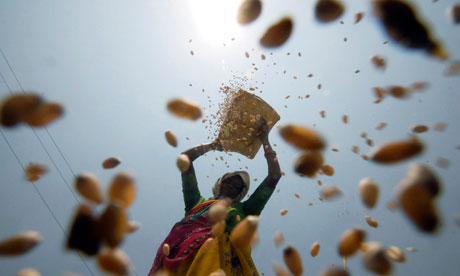
Than it was our turn to take to the microphone and give a rousing close about the weaknesses of the proposed treaty, the cost of 20-years delay, and the need now to go beyond zero and take more carbon from the atmosphere than is being emitted. “Emissions reductions will not save us now,” we said, “but photosynthesis can.” We pointed to the sources and sinks, saying the atmosphere was passing its pollutants and heat to the oceans but the oceans were already overwhelmed. Only vegetation and soil remained as viable sinks. As climate warms further, as it must, they too will be stressed and absorption will diminish. Time is of the essence. We showed our slide from Exxon's recent report saying that the world will still be 85% dependent on fossil fuels in 2040. They base their conclusion on images such as this one, and assume that everyone would just as soon exchange the bullocks and handmade plow for a large horsepower tractor.

Actually, that method of plowing is obsolete. It releases gigatons of greenhouse gases from the very place where we can still safely store them — in the soil. That style is being replaced with a suite of tools that produce more food per land area and net sequester more carbon every year, build soil, store water, and increase the resiliency of land to withstand storms, floods and droughts. Our tools include no-till organic farming, agroforestry, aquaponics, keyline design, holistic management, remineralization, biochar from biomass energy production, and permaculture. According to recent report by the UN Commissioner on Human Rights, “ecoagriculture” is the ONLY way we are going to feed the population of the world by 2040. Then we need to go beyond that and perform what Mark Shepard calls “restoration agriculture,” building back the web of life and returning us to a garden planet. Click on the link below for the complete blog.

http://peaksurfer.blogspot.com/2015/12/taking-our-carrots-to-paris.html


Wednesday, April 2, 2014

Geoff Lawton's Permaculture Design Course (Online)

For Those Who May Be Interested
If you are interested in growing your own food and if you have a farm this course is excellent.

Last year saw the launch Geoff Lawton's first online Permaculture Design Certificate (PDC) course, with the hope of exponentially increasing our educational reach. It was a 'scary' undertaking, in that, being the first course, we were not sure what to expect.


But we are proud to share that the course brought an overwhelmingly positive response. I've been looking around the inner 'halls' of the course system and reading comment after positive comment, and I've seen many of the amazing designs the students submitted at the end of their training. The best news is that this course is reaching people who would otherwise never get to take a PDC course, due to remote locations, family and work commitments, health constraints, cost, etc. Doctors, lawyers, housewives, politicians, activists, nurses, rural farmers, urbanites, pilots, industrialists, even experienced Permaculture teachers - the list goes on - all are coming together in the same system to learn, share, network and cause ripples of influence we may never be able to measure.


This last weekend Geoff's second online PDC was opened for registrations - for the new and even more expansive 2014 course (we keep adding material!). This course is run only once per year, and the door for registrations closes this Sunday, April 6th, 2014. If you want to get onto this course, or if you know someone who should, there's only three days left before the door shuts until next year, and the course begins. More


If you're unsure of the value of this life-altering course, please take a few minutes to scan the many comments below this post: http://permaculturenews.org/2013/10/28/geoff-lawtons-online-permaculture-design-course-worth/


Monday, December 30, 2013

Peak oil – reached. Peak water – reached. Next on the list? Peak soil

Soil is becoming endangered – this is the reality a meeting between experts in Reykjavik has reached. They explain that this has to receive public awareness if we want to feed 9 billion by 2050.

The main culprit is the one also responsible for global warming: Carbon.

“Keeping and putting carbon in its rightful place needs to be the mantra for humanity if we want to continue to eat, drink and combat global warming, concluded 200 researchers from more than 30 countries”.

Indeed, for all the attention the air and water gets, soil seems to be the forgotten child, just because we don’t eat or drink it. But everything we eat comes from it.

“While soil is invisible to most people it provides an estimated 1.5 to 13 trillion dollars in ecosystem services annually,” Glover said at the Soil Carbon Sequestration conference that ended this week.

It’s practically impossible to calculate the benefits that soil brings us – a mere cup of soil contains some 500.000 species, including worms, ants, fungi, bacteria and other microorganisms. 99% of our food comes from it, directly or indirectly, compared to the only 1% we get from oceans.

Soil cleans water, keeps contaminants out of streams and lakes, and prevents flooding; it can also absord massive quantities of carbon. But as hard as it may seem – it’s really fragile.

“It takes half a millennia to build two centimetres of living soil and only seconds to destroy it,” Glover said.

Plowing, removal of crop residues after harvest, and overgrazing all leave soil naked and vulnerable to wind and rain, resulting in gradual, often unnoticed erosion of soil. Erosion not only destroys crops, causes landslides and other catastrophes, but also releases carbon into the air.

“Soil can be a safe place where huge amounts of carbon from the atmosphere could be sequestered,” said Rattan Lal of Ohio State University.

So we’ve pretty much screwed the atmosphere – unless practically all of science that we do now is wrong, that’s a fact. We’re well into doing the same to the water, as a massive, large scale water shortage seems like a matter of time. Are we going to do the same with soil? Are we going to try to milk the cow until it runs totally dry? We know what should be done, we have the technology, and we also have the money for it.

A Sad Example

About 1000 years ago, when the first settlers arrived there, Iceland was mostly covered by forests, lush meadows and wetlands. By the late 1800s, about 96 percent of all icelandic forrests were gone. Half of the grasslands were destroyed by overgrazing. Humans pushed the land way beyond the limit of sustainability, up to the point where it became barren.

Due to necessity, Iceland pioneered a number of groundbreaking techniques in terms of soil protection, but the results in the past 100 years are moving extremely slowly.

“We’re still fighting overgrazing here,” Halldórsson said.

But the public is living in the urban areas, has forgot these troubles, and is not supporting land restoration anymore.

“The public isn’t supporting land restoration. We’ve forgotten that land is the foundation of life,” Halldórsson said.

More


Wednesday, July 20, 2011

Ensuring fair shares in a world of limits

As worldwide demand increases for natural resources that are already in short supply, how should aid donors and campaigners respond? 

As the 21st-century global economy increasingly hits natural resource limits and planetary boundaries, fundamental questions about fair shares will start to arise. How these arguments play out will exert a crucial influence over prospects for poor people and international development. Are aid donors, NGOs and other development opinion-formers paying attention?

Demand for resources of all kinds – especially food, oil, land, water and "carbon space" for greenhouse gas emissions in the atmosphere – is growing exponentially. It's a logical consequence of the world's population continuing to grow, and the global middle class becoming larger and more affluent.

But even as demand grows, supply is struggling to keep up. The yield gains of the agricultural "green revolution" are running out of steam. Competition for land and water is intensifying. Investment in new oil production is inadequate to meet future demand, according to the International Energy Agency – even before peak oil is taken into account. Carbon space is acutely limited if the world is to limit global warming to anything like 2C. More >>>